
The Lord Is My Shepherd
Psalms 1-2; 8; 19-33; 40; 46 · August 17–23, 2026
The Psalms give faithful language for trust, worship, repentance, sorrow, hope, and the quiet assurance that Jesus Christ leads His people home.
Monday, August 17
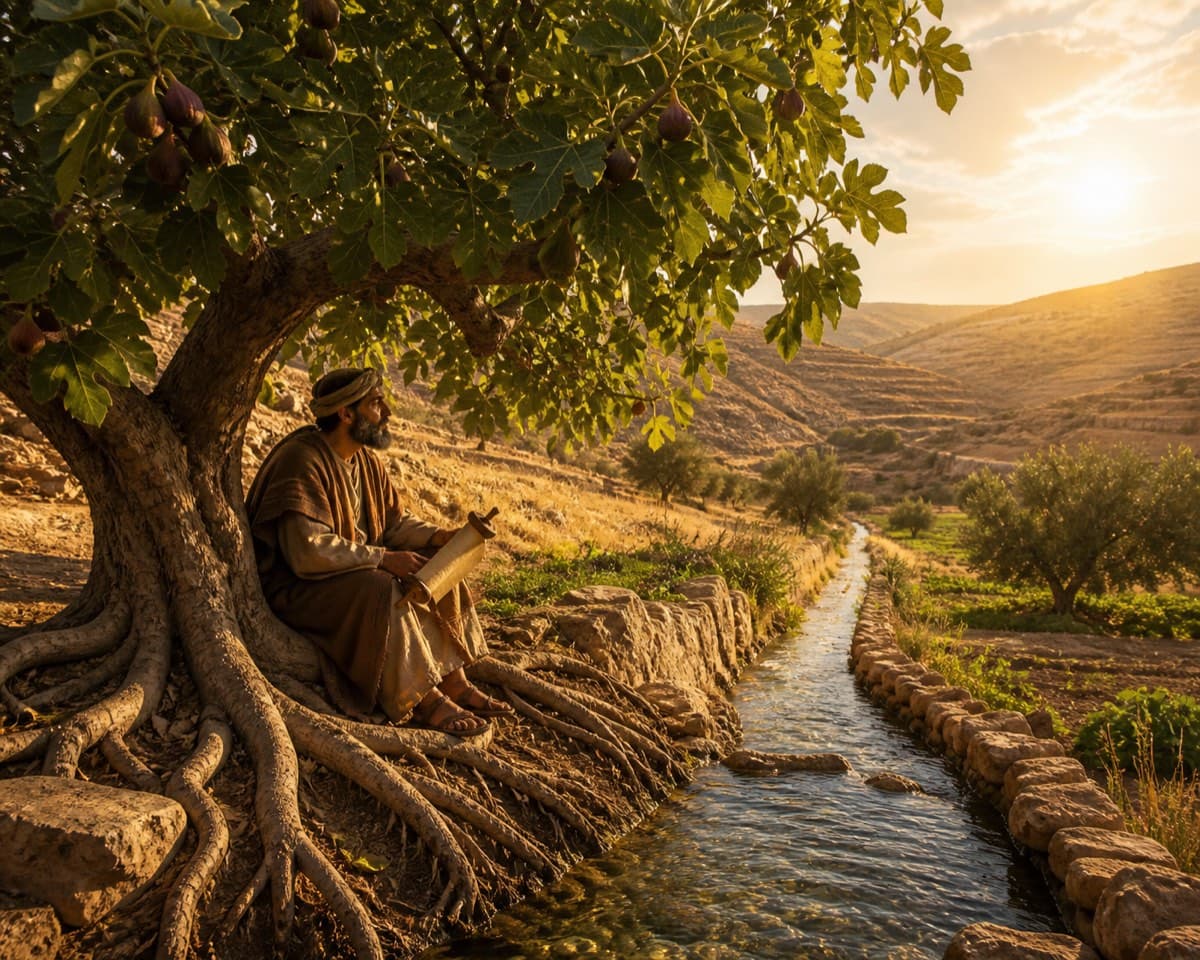
Planted by Living Waters
The book of Psalms opens with a deliberate contrast between two ways of living. One person is steadily shaped by the counsel of the ungodly, while another delights in the law of the Lord and meditates upon it day and night. The faithful life is compared to a tree planted beside channels of water. Its strength is not frantic self-sufficiency. The tree flourishes because its roots remain near a reliable source of life. Its fruit comes in season, its leaves endure heat, and its growth is patient rather than spectacular.
Psalm 1 does not promise that disciples will avoid every drought. The Psalms themselves contain grief, fear, opposition, and unanswered cries. The image instead teaches where lasting spiritual life comes from. Repeated attention to God's word sends roots beneath changing circumstances. Scripture, prayer, covenants, Sabbath worship, and the sacrament turn the soul toward Jesus Christ, the source of living water. Over time, these practices become more than tasks. They shape desire, judgment, and reflex so that trust in the Lord becomes the soul's settled orientation.
The final verse says that the Lord knows the way of the righteous. In scripture, divine knowing is relational and covenantal. God is not merely aware of the faithful path from a distance; He watches over those who walk it. Jesus Christ is both the perfectly righteous King anticipated in Psalm 2 and the Shepherd who accompanies His people. Rooted discipleship therefore joins personal constancy with confidence in Him. Human strength cannot make every leaf remain green, but Christ can nourish, prune, forgive, and restore. A life planted near Him can bear fruit at the proper time, even when its present season feels hidden or dry.
Questions to ponder and discuss
- Psalm 1 compares a faithful disciple to a tree planted beside water. What spiritual roots help you keep growing and bearing good fruit through changing seasons?Psalm 1:1-6
- The Lord knows the way of the righteous. How is being known and watched over by Him different from expecting a life without hardship?Psalm 1:3, 6; Psalm 23:1-4
Tuesday, August 18
The Promised King and Suffering Messiah
Several psalms look beyond the immediate circumstances of ancient Israel toward the Anointed One, the Messiah. Psalm 2 pictures nations raging against the Lord and His chosen King, yet their opposition cannot cancel God's decree. The New Testament applies this language directly to Jesus Christ. His Resurrection declares Him to be the Son of God with power, and His kingdom will finally reach every nation. Political force, public mockery, and death itself could not overthrow the Father's work.
Psalm 22 approaches the Messiah from another direction. It begins with the cry Jesus spoke from the cross and describes scorn, exposed wounds, and the dividing of clothing. The psalm does not end in abandonment. Its movement is from anguished lament to answered prayer, public praise, and a worldwide remembrance of the Lord. Christ entered the deepest loneliness of mortal suffering, fulfilled scripture, and conquered death. Because He descended below all things, His disciples can speak honestly when God seems distant without concluding that covenant promises have failed. Lament can be the first movement of a song whose ending is praise.
Together, Psalms 2 and 22 reveal a Messiah whose majesty and suffering belong to one redemptive mission. Jesus is not a powerless victim who later happens to become King, nor a distant ruler unfamiliar with pain. He reigns because He loved perfectly, offered Himself willingly, and rose in glory. Some messianic promises await complete fulfillment when every knee bows and the earth recognizes His rule. Meanwhile, the Church proclaims the risen Christ and invites all people to trust Him. The promised King bears wounded hands. His authority is therefore both absolute and compassionate, giving hope to every soul who feels opposed, forsaken, or afraid.
Questions to ponder and discuss
- Which image in Psalm 23—green pastures, still waters, the rod and staff, a prepared table, or an overflowing cup—best describes what you need from the Savior right now? Why?Psalm 23:1-6
- What does it look like in ordinary life to let Jesus Christ shepherd you instead of insisting that you already know the safest path?Psalm 23:1-4; John 10:11, 14-16
- Think of a time the Lord restored your soul through another person, a scripture, prayer, music, or quiet reassurance. What made that help feel personal?Psalm 23:3
Wednesday, August 19
Crowned with Glory beneath the Heavens
Psalms 8, 19, and 33 look outward at the heavens and then inward at the astonishing worth of human souls. The night sky makes humanity appear small, yet the psalmist does not conclude that people are insignificant. He marvels that the Creator remembers and visits them. Men and women are God's children, crowned with glory and honor and entrusted with stewardship over His works. Creation communicates both divine grandeur and personal belonging.
Psalm 19 declares that the heavens tell God's glory without audible speech. Day and night continuously bear witness through order, beauty, light, and immensity. Modern knowledge of galaxies, ecosystems, and living cells only enlarges the wonder. Yet creation alone does not disclose the whole covenant path. The psalm turns from the sun in the heavens to the law of the Lord, which enlightens the eyes and rejoices the heart. The God who orders the cosmos also speaks moral and saving truth. His creations awaken reverence; His word teaches how His children should live.
Jesus Christ stands at the center of both witnesses. Under the Father's direction, He created the earth, and through His Atonement He restores fallen humanity to its divine possibilities. The same Lord who counts stars also notices individual souls. That union of majesty and nearness corrects two errors: creation is not divine and should not be worshipped, but neither is it spiritually empty. It is God's workmanship, given for human joy, learning, and responsible care. Wonder becomes worship when it leads to gratitude, humility, stewardship, and love for each person. To behold the heavens faithfully is to remember that the Creator of such vastness chose to know, redeem, and crown His children through Jesus Christ.
Questions to ponder and discuss
- The New Testament writers recognized details of Jesus Christ's life in Psalms 2, 22, and 31. Which connection most strengthens your confidence that He is the promised Messiah?Psalm 2:1-7; Psalm 22:1, 7-8, 16-18; Psalm 31:5
- Psalm 22 moves from anguish to praise and a vision of future generations remembering the Lord. How can Christ's Resurrection transform the meaning of suffering without pretending the suffering was small?Psalm 22:1-5, 22-31; Matthew 27:45-46; Hebrews 2:9-12
Thursday, August 20
The Voice That Rejoices the Heart
Psalm 19 moves from the speechless witness of creation to the articulate gift of revelation. The Lord's law is perfect, His testimony sure, His statutes right, and His commandment pure. These descriptions resist the idea that commandments are arbitrary restraints. God's word restores the soul, creates wisdom, produces joy, and brings light because it comes from a perfectly loving and truthful source. Divine direction reveals both the path and the dangers that would otherwise remain hidden.
Psalm 29 describes the voice of the Lord with the force of a thunderstorm crossing the land. It breaks cedars, shakes wilderness, and makes the forest bare. Yet the psalm ends not with terror but with the Lord giving strength and peace to His people. God's voice can overturn pride, pierce rationalization, and call a wandering soul to repent, but its covenant purpose is life. The same word that exposes sin also testifies of Jesus Christ, announces forgiveness, and teaches how to return.
Receiving the Lord's word includes scripture, prophetic teaching, inspired worship, and personal revelation through the Holy Ghost. These witnesses agree in leading souls to Christ and into covenant faithfulness. Personal impressions never make disciples independent of revealed doctrine; they help apply eternal truth to particular circumstances. The response envisioned by the psalm is more than hearing. God's words become the meditation of the heart and then the words of the mouth. They shape worship, choices, and speech. As disciples treasure revelation, the voice that shakes cedars also becomes a quiet source of courage. Jesus Christ is the Rock and Redeemer who makes divine correction safe to receive. His word is powerful enough to change a heart and gracious enough to rejoice it.
Questions to ponder and discuss
- When you look at the heavens or the earth, what makes you feel both small and deeply valued by Heavenly Father?Psalm 8:1-9; Psalm 19:1-6
- How can gratitude for God's creations change the way we treat the earth, other living things, and one another?Psalm 8:3-9; Psalm 33:5-9
- What part of creation most reliably turns your thoughts toward the Creator, and what does it teach you about Him?Psalm 19:1-4; Psalm 33:5
Friday, August 21
Clean Hands and a Pure Heart
Psalm 24 asks who may ascend the hill of the Lord and stand in His holy place. The answer names clean hands, a pure heart, freedom from idolatry, and honest speech. Hands represent outward actions; the heart represents motives, desires, and loyalties. God seeks integrity in both. Temple worship is therefore not a performance of visible respectability but a covenant approach to the Holy One, whose grace reaches behavior and desire.
The standard can feel overwhelming when purity is mistaken for flawless self-achievement. The gospel gives a different source of hope. No mortal except Jesus Christ has perfectly clean hands and a perfectly pure heart by personal merit. He invites all to repent, receive ordinances, keep covenants, and be sanctified through His Atonement. Worthiness is honest, faithful participation in that process. Repentance is not evidence that discipleship has failed; it is one of the central ways disciples continually come unto Christ.
Psalms 26 and 27 add love for the Lord's house and confidence in His light. The temple directs worshippers toward the Savior's cleansing sacrifice, eternal family, and the presence of the Father. Its holiness does not announce that imperfect people are unwanted. It teaches that Christ can prepare them to enter and that becoming holy is possible through covenant belonging. The King of glory in Psalm 24 is the same Lord who opens the way. As disciples yield sins and desires to Him, clean hands and a pure heart become more than admission requirements. They describe the person He is patiently creating: honest in conduct, undivided in devotion, and eager to dwell in God's presence.
Questions to ponder and discuss
- Psalm 19 describes the Lord's word as converting the soul, making wise, rejoicing the heart, and enlightening the eyes. Which of those blessings have you experienced through scripture or personal revelation?Psalm 19:7-11; Psalm 29:3-11
- President Dallin H. Oaks taught that hymns can put us in tune with the Spirit and communicate our love for the Lord. When has sacred music taught or testified to you in a way ordinary speech did not?Psalm 33:1-6; Doctrine and Covenants 25:12
Saturday, August 22
Joy Comes in the Morning
Psalm 30 refuses to flatten mortal life into either constant happiness or permanent sorrow. The psalmist remembers crying to the Lord, being lifted from danger, and discovering that weeping may endure for a night while joy comes in the morning. Night can be painfully long. Faith does not require grief to disappear on command, and the verse does not accuse those whose sorrow lasts through many mornings. It testifies instead that sorrow does not possess the final word in God's plan.
Jesus Christ gives that promise its deepest foundation. On the night before His Crucifixion, He entered Gethsemane and carried the sins, pains, sicknesses, and griefs of all humanity. His body lay in a tomb, and His disciples mourned what appeared to be the collapse of every hope. On the first day of the week, the tomb was empty. The risen Savior transformed the meaning of death, not by denying its anguish but by overcoming it. Because He lives, every body will rise, covenant relationships can continue eternally, and faithful losses can be restored in God's time.
Psalm 30 describes mourning turned into dancing and sorrowful clothing replaced with gladness so that the redeemed soul can sing praise. Resurrection is the great morning toward which every lesser deliverance points. Some joy arrives now through comfort, healing, repentance, family, service, and the Holy Ghost. Some waits beyond mortality. Both forms are secured by the living Christ. Disciples can therefore honor grief without worshipping despair. They may mourn with those who mourn while bearing quiet witness that divine joy is more durable than death. The promise of morning is not a timetable imposed upon the hurting. It is the risen Lord's covenant assurance that darkness will finally yield.
Questions to ponder and discuss
- Psalm 24 asks who may ascend the hill of the Lord and answers, “He that hath clean hands, and a pure heart.” How does the Savior make that invitation hopeful instead of overwhelming?Psalm 24:1-6; 3 Nephi 27:19-20
- How can we encourage high and holy standards while also helping people understand that worthiness is not flawlessness?Psalm 24:3-6; Moroni 10:32-33
- What is one way temple worship—or preparing to worship in the temple—has helped turn your heart toward Jesus Christ?Psalm 24:3-6; Psalm 27:4-8
Sunday, August 23
Be Still and Know
Psalm 46 describes a world in upheaval: earth shifts, mountains fall into the sea, waters roar, and nations rage. Faith is not portrayed as confidence that nothing frightening will happen. It is confidence that God remains a present refuge when foundations shake. The repeated declaration, "the Lord of hosts is with us; the God of Jacob is our refuge," anchors the poem. His presence, not favorable circumstances, is the deepest source of security.
The command "Be still, and know that I am God" comes after scenes of conflict. Stillness includes quiet prayer, but its scriptural force is larger than relaxation. It calls striving powers to cease and covenant people to release their frantic attempt to control what belongs to God. He will be exalted among the nations and throughout the earth. Disciples can act courageously while surrendering ultimate outcomes to Him. Holy stillness is alert trust: listening for the Spirit, remembering revealed truth, and refusing to let noise become the soul's master.
Jesus Christ embodies and grants this peace. He calmed the sea, yet He also sustained disciples through storms that continued. Through His Atonement, He reconciles sinners to God, breaks the weapons of death, and establishes a peace the world cannot give. Regular stillness makes room to recognize His presence in scripture, sacrament, temple worship, nature, and quiet acts of service. It also prepares disciples to become peacemakers rather than additional sources of turmoil. The week of psalms ends where it began: not with human control, but with rooted trust. The Shepherd, Messiah, Creator, speaking Lord, cleansing King, and risen Redeemer is also the refuge who remains present. Souls can become still because He is God, He is with them, and His saving work will prevail.
Questions to ponder and discuss
- Psalm 30 says that weeping may endure for a night, but joy comes in the morning. How has Jesus Christ helped you hold hope during a night that lasted longer than you expected?Psalm 30:1-12; Psalm 40:1-3
- “Be still, and know that I am God” was spoken amid roaring waters, shaking mountains, and conflict. What kind of stillness is possible even when life around you is not quiet?Psalm 46:1-11
These are supplemental study notes written by Rooted, an independent app not affiliated with The Church of Jesus Christ of Latter-day Saints. For the official lesson, see Come, Follow Me on churchofjesuschrist.org.