
Let Every Thing That Hath Breath Praise the Lord
Psalms 102–103; 110; 116–119; 127–128; 135–139; 146–150 · August 31 – September 6, 2026
Finding comfort, direction, covenant hope, and wholehearted praise in the closing songs of Psalms.
Monday, August 31
The Lord Hears the Prayer of the Destitute
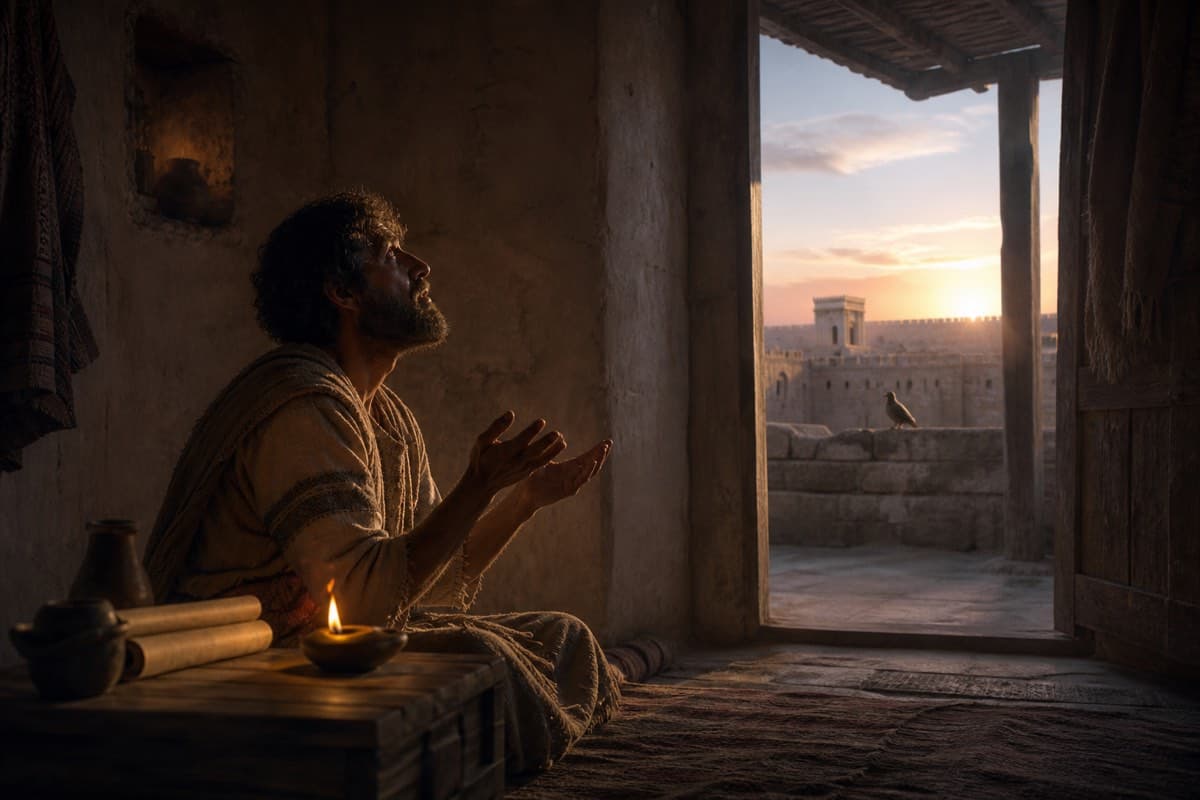
Psalm 102 begins without pretending that discipleship makes sorrow painless. The afflicted worshipper feels consumed like smoke, withered like grass, sleepless and alone. Even food has become difficult, enemies add reproach to grief, and the passing days seem like a lengthening shadow. This is sacred language for experiences that can otherwise feel unspeakable. The psalm does not condemn the sufferer for anxiety or isolation. It carries those feelings directly into prayer: “Hear my prayer, O Lord, and let my cry come unto thee.” Lament becomes an act of faith because it addresses the Lord rather than surrendering to silence.
The turning point arrives with the words “But thou, O Lord, shalt endure for ever.” The situation has not yet changed, but the worshipper looks beyond the limits of one mortal life to the permanence of God. The Lord will arise, show mercy, build Zion, and regard the prayer of the destitute. Psalm 116 develops the same trust through remembered deliverance. The psalmist loves the Lord because He heard a pleading voice and bent near in compassion. Calling on the Lord is not a transaction that earns an easy life; it is covenant dependence upon One whose character does not change.
Jesus Christ gives the fullest meaning to this hope. He descended below all things and knows pain from within mortal experience. Through His Atonement, no honest cry is wasted and no righteous suffering is final. Relief may come as healing, sustaining strength, companionship, clearer direction, or assurance that resurrection will repair what mortality cannot. Psalm 102 ends by contrasting a changing creation with the unchanging Lord. He remains the same, and the children of His servants will continue before Him. That perspective does not minimize present anguish. It places anguish within a story governed by a Redeemer who hears, remembers, and eternally restores.
Questions to ponder and discuss
- Psalm 102 begins with loneliness and distress, while Psalm 103 remembers the Lord's mercy and healing. Which truth about the Savior helps you turn toward Him when your feelings make Him seem far away?Psalm 102:1-12; Psalm 103:1-13
- Psalm 116 says the Lord hears our voice and our pleas. What helps a person keep praying when relief is not immediate?Psalm 116:1-9
Tuesday, September 1
Forget Not All His Benefits
Psalm 103 is a deliberate act of remembrance. The psalmist addresses his own soul: “Bless the Lord, O my soul: and all that is within me, bless his holy name.” This is more than an emotional outburst. He gathers attention, memory, and desire and directs them toward God. “Forget not all his benefits” suggests that spiritual forgetfulness is a recurring mortal danger. Pain can make mercy feel distant; prosperity can make mercy seem unnecessary. Worship restores truthful memory in both conditions.
The remembered benefits form a portrait of salvation. The Lord forgives iniquities, heals diseases, redeems life from destruction, crowns with loving-kindness, satisfies with good things, and executes righteousness for the oppressed. These blessings do not promise that every illness ends immediately or that every injustice is resolved in mortality. They reveal the direction and final completeness of God’s work through Jesus Christ. Forgiveness addresses guilt, healing addresses brokenness, redemption defeats death, and covenant love gives the redeemed a new identity.
The center of the psalm is the Lord’s merciful character. He is slow to anger, does not deal with repentant people according to their sins, removes transgressions as far as east is from west, and pities His children as a compassionate father. He remembers that mortals are dust. Divine remembrance therefore answers human forgetfulness: while people forget blessings and even forget who they are, God remembers their frailty and His covenant.
Human life is like grass, brief and vulnerable, but the mercy of the Lord is “from everlasting to everlasting” upon those who fear Him. Covenant obedience is not a way of buying that mercy. It is the way grateful children remain turned toward the Father who gives it. Psalm 103 teaches the soul to rehearse grace until praise becomes comprehensive—“all that is within me”—and personal gratitude widens into the closing invitation for angels, hosts, works of creation, and every place of God’s dominion to bless the Lord.
Questions to ponder and discuss
- What do the titles and images in Psalms 110 and 118 teach you about the power, authority, and saving mission of Jesus Christ?Psalm 110:1-4; Psalm 118:22-26
- The stone rejected by the builders became the chief cornerstone. How can remembering the Savior's rejection help us follow Him when discipleship is unpopular or misunderstood?Psalm 118:21-24; Matthew 21:42; Acts 4:10-12
- The people welcomed Jesus with words from Psalm 118. What would it look like for you to welcome the Savior more fully into one part of your life this week?Psalm 118:25-29; Matthew 21:6-11
Wednesday, September 2
The Stone Which the Builders Refused
Psalms were Israel’s worship long before the mortal ministry of Jesus Christ, yet the New Testament repeatedly uses them to identify Him. Psalm 110 speaks of a royal figure invited to sit at the Lord’s right hand and also declares, “Thou art a priest for ever after the order of Melchizedek.” Psalm 118 celebrates the rejected stone becoming the chief cornerstone and welcomes the one who comes in the name of the Lord. Jesus and His Apostles taught that these words converged in Him.
When Jesus asked how the Messiah could be both David’s son and David’s Lord, He did not deny His descent from David. He revealed that the promised Messiah was greater than a merely political heir. He is the premortal Lord who condescended to enter David’s family line. Hebrews uses Psalm 110 to testify that Christ’s priesthood is eternal and His sacrifice complete. He is King and High Priest, possessing both authority to rule and power to reconcile humanity to God.
The cornerstone image adds rejection and reversal. Builders examine a stone and discard it as unsuitable, but God makes that same stone essential to the whole structure. During His mortal ministry, religious and political authorities rejected Jesus. His Crucifixion appeared to confirm their verdict, yet the Resurrection revealed the Father’s. The rejected Christ is the foundation of salvation, the name by which healing and eternal life come.
On the road into Jerusalem, worshippers cried words from Psalm 118: “Hosanna” and “Blessed is he that cometh in the name of the Lord.” Hosanna is both praise and a plea to save. That combination captures discipleship. Saints rejoice that the King has come and continually depend upon Him for rescue. Reading the Psalms through their inspired New Testament fulfillment does not empty them of ancient meaning. It shows how Israel’s worship prepared language, expectation, and covenant memory to receive the Messiah.
Questions to ponder and discuss
- Psalm 119 compares God's word to a lamp for the next step on a journey. When has scripture given you enough light to move forward even without showing you the whole path?Psalm 119:97-105
- President Russell M. Nelson compared scripture to a road map that helps us recognize wrong turns, repent, and return to the path. Why is correction a gift rather than a sign that the journey has failed?Psalm 119:9-16, 33-37, 59-60; 2 Nephi 31:17-21
Thursday, September 3
A Lamp unto My Feet
Psalm 119 is the longest psalm and an extended celebration of God’s revealed word. Its many names for divine instruction—law, testimonies, ways, precepts, statutes, commandments, judgments, and word—show that revelation is not a burden imposed upon an otherwise free life. It is a gift that makes covenant freedom possible. The psalmist lives among affliction, opposition, distraction, and personal weakness, yet repeatedly turns to the Lord’s word for life, understanding, cleansing, hope, and direction.
The famous image “Thy word is a lamp unto my feet, and a light unto my path” describes enough light for faithful movement. An ancient lamp did not illuminate an entire distant landscape like a modern floodlight. It made the next portion of the path visible. Revelation often works in this manner. God provides commandments, scripture, prophetic counsel, covenants, and the Holy Ghost so disciples can take the next right step without receiving every detail of the journey in advance. Trust grows through walking in received light.
The psalm’s journey words—walk, way, path, feet, wander—make obedience dynamic. A covenant life is not simply agreement with true ideas. It is movement toward Heavenly Father through Jesus Christ. Wandering can begin through neglect as easily as rebellion, which is why the psalmist treasures, meditates upon, remembers, and speaks God’s word. Repentance is the merciful correction that turns wandering feet back toward the path.
President Russell M. Nelson compared scripture to a road map that helps travelers recognize errors, stop, correct direction, and continue along the strait and narrow path. The image protects against both despair and presumption. Mistakes do not require remaining lost, and sincerity alone does not make every road equally safe. The Savior is the way home. His word reveals the path, His grace makes repentance possible, and His Spirit gives living guidance as disciples continue toward eternal life.
Questions to ponder and discuss
- Psalm 135 describes idols with mouths, eyes, and ears that cannot speak, see, or hear. What modern substitutes for God can appear powerful while remaining unable to save or truly know us?Psalm 135:5-18
- Psalm 136 answers each remembered act of God with the same declaration: His mercy endures forever. Which act of the Lord in your life would you pair with that declaration?Psalm 136:1-9, 23-26
- How can regular praise protect us from giving money, achievement, popularity, technology, or comfort a place in our hearts that belongs to God?Psalm 135:15-21; Psalm 136:23-26
Friday, September 4
Children Are an Heritage of the Lord
Psalms 127 and 128 sing about work, home, children, labor, worship, and peace. They do not present family life as effortless or guarantee that every righteous person will experience the same mortal circumstances. Instead, they locate the household within dependence on God. “Except the Lord build the house, they labour in vain that build it.” Human effort matters—the builders truly labor and the watchman truly wakes—but effort cannot replace the Lord as foundation, protector, and giver.
Psalm 127 also corrects anxious striving. Rising early, staying up late, and eating “the bread of sorrows” can describe work detached from trust. The Lord’s beloved still labor diligently, yet they receive sleep as a gift and recognize that providence, not panic, sustains life. This is not permission for passivity. It is a covenant order in which work serves holy purposes rather than becoming a rival god.
Children are called “an heritage of the Lord” and a reward. Heritage language emphasizes gift and stewardship before possession. Children belong first to God and carry divine identity and potential. Parents are entrusted to love, teach, protect, and lead them toward Jesus Christ. The comparison to arrows highlights direction and preparation: an arrow is carefully shaped and sent beyond the archer’s present reach. Wise parenting seeks not control but consecrated formation that helps a child exercise agency in truth.
Psalm 128 widens the household blessing to Zion and future generations. Reverence for the Lord shapes honest labor, shared abundance, fruitful relationships, and peace. Some images reflect the agrarian household of ancient Israel, but the covenant principles extend to many faithful circumstances: homes can become places of prayer, belonging, service, repentance, and gospel teaching. Those who are single, childless, widowed, divorced, or separated from loved ones remain fully within God’s family and promises. In Christ, covenant belonging reaches beyond present household patterns, and every righteous contribution to nurturing God’s children participates in His work of building an eternal home.
Questions to ponder and discuss
- Psalm 139 teaches that the Lord knows our thoughts, paths, words, strengths, and weaknesses. Which part of being completely known by Him feels most comforting to you?Psalm 139:1-12
- The psalmist asks God to search his heart and lead him in the everlasting way. What is the difference between inviting loving correction from the Lord and simply criticizing yourself?Psalm 139:17-18, 23-24
Saturday, September 5
O Lord, Thou Hast Searched Me
Psalms 135–139 contrast powerless idols with the living Lord who creates, delivers, remembers, and knows. Idols possess mouths, eyes, ears, and breathless forms but cannot speak, see, hear, or respond. Those who trust them become like them—spiritually unresponsive to truth and covenant love. The Lord, by contrast, acts in history, rules creation, hears His people, and knows each person completely.
Modern idols are rarely carved from silver or gold, but the spiritual pattern persists whenever created things receive the trust and allegiance owed to God. Wealth, status, image, ideology, technology, appetite, achievement, or another person can promise control and identity while remaining unable to redeem. An idol narrows perception until a worshipper resembles the object of devotion. The living God enlarges perception and makes disciples more alive, truthful, compassionate, and holy.
Psalm 139 brings divine knowledge into intimate focus. The Lord knows sitting and rising, thought and word, travel and rest. No distance or darkness places a person outside His presence. This can initially feel exposing because disciples know their own divided motives and hidden failures. Yet the psalm treats God’s knowledge as wonder and refuge. The One who sees completely is also the One who formed life with care and whose thoughts are precious. He knows weakness without contempt and potential without illusion.
The closing prayer—“Search me, O God, and know my heart”—freely welcomes the knowledge already described. The worshipper asks God to reveal anxious and wicked ways and lead toward everlasting life. Repentance flourishes under perfect love because nothing needs to be hidden and nothing false needs to be defended. Through Jesus Christ, being fully known can become the beginning of healing rather than condemnation. The Lord’s searching light exposes idols, clarifies desire, and guides a willing heart into the everlasting way.
Questions to ponder and discuss
- Psalm 146 warns against placing ultimate trust in mortal leaders, then praises the Lord's care for the oppressed, hungry, captive, blind, bowed down, stranger, widow, and fatherless. How should worship change the way we notice and serve people?Psalm 146:3-10
- Psalms 147–150 praise the Lord through healing, creation, music, movement, and breath. Which form of praise helps your gratitude to Heavenly Father and Jesus Christ become more sincere?Psalm 147:1-11; Psalm 149:1-4; Psalm 150:1-6
- Why does praising the Lord deepen faith even though He already knows His own goodness and does not need our approval?Psalm 147:1; Psalm 148:1-14; Psalm 150:6
Sunday, September 6
Let Every Thing That Hath Breath Praise
The book of Psalms closes with five hymns that begin and end with Hallelujah—“Praise ye the Lord.” The progression is expansive. Psalm 146 begins with one soul choosing lifelong praise and refusing ultimate trust in mortal rulers. Psalm 147 gathers Jerusalem and celebrates the God who heals broken hearts, names the stars, governs creation, and gives His word to Israel. Psalms 148 and 149 summon heaven, earth, rulers, peoples, old and young, and the covenant congregation. Psalm 150 brings praise into the sanctuary and calls every instrument and every breathing creature into the final song.
Praise is not flattery offered to an insecure deity. It is truthful recognition that the Lord is Creator, covenant keeper, Deliverer, Healer, Judge, and King. Praise reorders attention. Mortal powers return to dust and cannot save eternally, but the God of Jacob keeps truth forever, executes judgment for the oppressed, feeds the hungry, frees captives, opens blind eyes, raises the bowed down, loves the righteous, and cares for the vulnerable. Naming these works shapes a community to value what God values.
The repeated commands to praise also show that worship can be chosen before a particular emotion arrives. Breath itself becomes a reason and means for praise. Singing, prayer, testimony, obedience, service, reverent music, and joyful movement can all acknowledge the Giver. Different instruments contribute distinct sounds without losing unity, an image of a covenant people whose varied gifts are consecrated to one Lord.
The final word of the Psalter is Hallelujah. Lament, confession, royal hope, wisdom, suffering, history, and thanksgiving have all appeared, and praise does not erase any of them. Instead, it reveals their promised destination. Through Jesus Christ, sorrow will be healed, death defeated, scattered Israel gathered, and all creation renewed. Every borrowed breath can anticipate that future now by becoming witness: Praise the Lord.
Questions to ponder and discuss
- Psalm 127 teaches that even diligent building and watchfulness depend on the Lord. How can we work wholeheartedly while remembering that lasting success is a gift from Him?Psalm 127:1-2; Proverbs 3:5-6
- Looking back over this week, what blessing, rescue, truth, relationship, or ordinary gift most makes you want to praise the Lord?Psalm 103:1-5; Psalm 116:12-14; Psalm 150:1-6
These are supplemental study notes written by Rooted, an independent app not affiliated with The Church of Jesus Christ of Latter-day Saints. For the official lesson, see Come, Follow Me on churchofjesuschrist.org.