
If the Lord Be God, Follow Him
1 Kings 12-13; 1 Kings 17-22 · June 29 – July 5, 2026
Covenant loyalty, quiet revelation, and choosing the Lord when other voices compete.
Monday, June 29
A King Who Would Not Serve
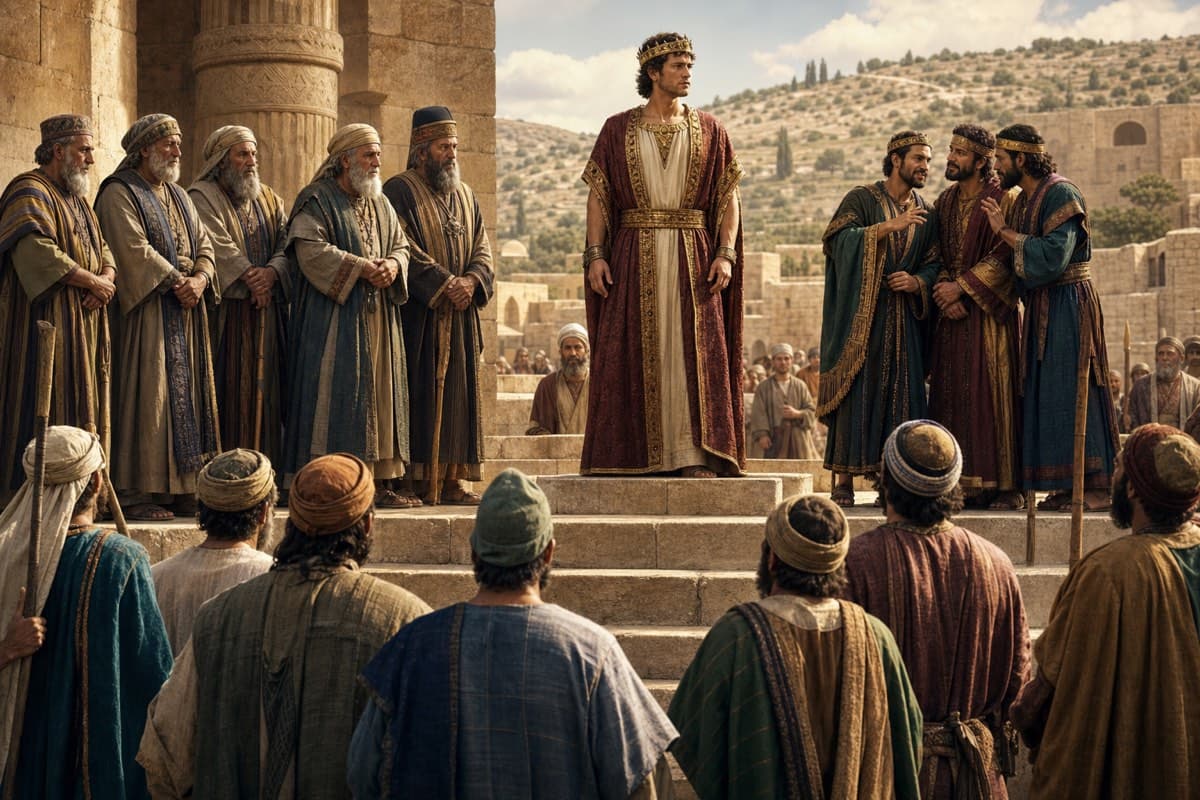
The division of Israel after Solomon's reign begins with a leadership failure. The people come to Rehoboam asking for relief from heavy burdens. Older counselors urge him to serve the people, speak good words, and win their loyalty through humility. Younger counselors tell him to answer with harshness and display strength through increased pressure. Rehoboam chooses the counsel that flatters power rather than the counsel that preserves covenant unity.
The tragedy is not only political. Israel is the Lord's covenant people, and leadership among the covenant people is supposed to reflect God's character. Rehoboam treats stewardship as domination. He confuses authority with self-protection and misses the Christlike pattern later taught by the Savior: true greatness comes through ministering, serving, and giving one's life for others. In scripture, unrighteous leadership often fractures community because it teaches people to fear rather than trust.
The account also shows how quickly inherited blessings can be damaged by pride. Rehoboam receives a kingdom shaped by David's covenant and Solomon's temple, yet he does not receive the heart needed to care for it. Spiritual inheritance is precious, but it must be renewed through personal humility. A person can inherit a calling, a family tradition, a testimony environment, or sacred opportunities and still need to choose the Lord's way in the actual moment of decision.
For disciples of Jesus Christ, Rehoboam's mistake turns leadership into a matter of repentance and conversion. Everyone leads somewhere: in homes, classes, quorums, friendships, workplaces, digital spaces, and private self-government. Christlike leadership begins by asking what will bless God's children, not what will protect pride. The Savior's authority heals because He descends below all things, bears burdens, and invites trust. His disciples lead best when they remember that every stewardship belongs first to Him.
Tuesday, June 30
Counterfeit Altars
Jeroboam receives the northern kingdom with a divine promise that his house can be established if he walks in the Lord's ways. Yet fear soon governs him. He worries that if the people travel to Jerusalem to worship, their hearts will return to the house of David. Instead of trusting the Lord who gave him the kingdom, Jeroboam creates alternate worship centers at Bethel and Dan, makes golden calves, appoints priests outside the Lord's order, and invents a feast of his own devising.
The danger in 1 Kings 12 is not open atheism. Jeroboam still uses religious language. He gives the people visible worship, convenient locations, a familiar festival shape, and leaders who appear priestly. The problem is that the worship has been redesigned around fear, control, and political survival rather than revelation. Counterfeit worship often borrows sacred vocabulary while moving the heart away from covenant obedience.
The unnamed man of God in 1 Kings 13 exposes Jeroboam's altar and announces future judgment. His message shows that the Lord sees beyond public appearance. An altar can be popular and still be false. A practice can feel convenient and still train the soul away from God. The chapter also warns disciples who have received true direction to keep obeying it. The man of God is later deceived by another prophet's claim, and the story becomes a sobering reminder that revelation must be held with exactness and humility.
Modern disciples may not build calves at Bethel, but the temptation to redesign discipleship around comfort is familiar. The heart can create convenient altars out of preference, approval, control, entertainment, or selective obedience. The Lord invites His people to trust revealed worship, covenant ordinances, prophetic counsel, and the Holy Ghost more than anxious self-invention. True worship is not built by asking what will keep life manageable; it is built by asking what the Lord has commanded.
Wednesday, July 1
Meal Before Miracle
Elijah appears in a time of drought and covenant crisis. Ahab has led Israel deeper into Baal worship, and the land itself becomes a witness that the Lord, not Baal, commands rain and life. Before the public confrontation on Mount Carmel, however, the Lord teaches through quieter scenes of dependence. Ravens feed Elijah by the brook Cherith. Then the brook dries up, and the prophet is sent to a widow in Zarephath, outside Israelite territory.
The widow's situation is desperate. She has only a handful of meal and a little oil. She is gathering sticks to prepare what she expects will be a final meal for herself and her son. Elijah's request that she feed him first can sound severe until it is seen as an invitation into the Lord's promise. The widow is not asked to give because God needs her last food. She is invited to act in faith so the Lord can multiply what appears insufficient.
Her obedience is quiet, practical, and brave. She does not command fire from heaven or preach to a nation. She makes a small cake first for the prophet and trusts the word of the Lord. The barrel of meal and cruse of oil do not become storehouses of visible abundance. They are renewed day by day. The miracle teaches a kind of faith that lives close to need and learns that the Lord can sustain one faithful act at a time.
For Latter-day Saints, Zarephath is a sacred school of sacrifice. Disciples often want reassurance before obedience, but covenant faith frequently asks for a step before visible fullness appears. Tithing, temple worship, accepting callings, forgiving, serving, and choosing moral cleanliness can feel costly when resources are thin. The Savior knows hunger, poverty, loneliness, and sacrifice. He can make faithful offerings holy and sustain His people with enough for the next obedient step.
Thursday, July 2
Life Returned to the House
After the miracle of meal and oil, the widow of Zarephath faces a deeper sorrow. Her son becomes sick and dies. The story refuses to make faith simplistic. A household can be sustained by one miracle and still encounter another grief. The widow's first response carries anguish and spiritual fear. Elijah responds not with explanation, but with pleading prayer and priestly tenderness. He takes the child, carries him to an upper room, and cries unto the Lord.
The restoration of the widow's son is one of the Old Testament's tender witnesses that the Lord is God of life. Elijah stretches himself upon the child and prays that the child's soul will come into him again. The Lord hears, and the child revives. When Elijah returns the living son to his mother, she declares that she now knows Elijah is a man of God and that the word of the Lord in his mouth is truth.
This account does not answer every mortal question about suffering, timing, or why some prayers are answered visibly while others wait upon resurrection hope. It does teach that the Lord hears sorrow and that His prophets turn grief toward God. The miracle points beyond Elijah to Jesus Christ, who raises the dead, bears griefs, and will finally overcome death for every child of God. Every restoration of life in scripture is a sign pointing to the Savior's greater victory.
The widow's testimony grows through both provision and pain. She first learns that the Lord can sustain daily life. Then she learns that the Lord holds power over death. Disciples likewise come to know God across different kinds of need. Some days require bread. Some days require comfort. Some days require faith in resurrection. Jesus Christ is present in each need, and His word remains true even when the path to life passes through tears.
Friday, July 3
No More Halting
The confrontation on Mount Carmel is one of the Old Testament's most dramatic scenes, but its central question is direct and personal: 'How long halt ye between two opinions?' Israel has tried to live with divided allegiance. They have inherited the covenant of the Lord while giving space to Baal, the storm god whose worship was socially promoted by Ahab and Jezebel. After years of drought, the pressure to trust Baal would have felt culturally and materially powerful. Elijah calls the people to stop wavering.
The contest exposes the difference between noise and revelation. The prophets of Baal cry, leap, and cut themselves, but there is no voice. Elijah repairs the broken altar of the Lord, uses twelve stones to remember covenant Israel, drenches the sacrifice with water, and offers a simple prayer. Fire falls from heaven, consuming the sacrifice, wood, stones, dust, and water. The people fall on their faces and confess that the Lord is God.
The miracle is public and unmistakable, yet the story is not merely about spectacle. The Lord is reclaiming His people's hearts. Fire from heaven answers a covenant question: the God who lives is the God who should be followed. Elijah's prayer asks that the people may know the Lord is God and that He has turned their heart back again. The goal is not Elijah's vindication; it is Israel's return.
Modern disciples may also feel pressure to halt between opinions. Competing loyalties can include social approval, cynicism, entertainment, wealth, political identity, romance, resentment, or the desire to appear sophisticated. The Lord does not ask for occasional admiration mixed with rival worship. He invites covenant loyalty through Jesus Christ. The sacrament, temple covenants, daily repentance, and the gift of the Holy Ghost help disciples answer Carmel's question with a life that follows the living God.
Saturday, July 4
The Still Small Voice
After Mount Carmel, Elijah might have expected lasting reform. Instead, Jezebel threatens his life, and he flees into the wilderness. The prophet who stood before kings and called down fire now sits under a juniper tree and asks that he might die. Scripture does not hide his exhaustion. Great faith does not make a person immune to discouragement, loneliness, fear, or depletion. Elijah's collapse comes after obedience, public courage, and spiritual intensity.
The Lord ministers to him with tenderness. An angel gives food and water, lets him rest, and then gives more food for the journey. Before Elijah receives the revelation at Horeb, he receives sleep and nourishment. This detail matters. The Lord cares for embodied souls. Sometimes spiritual recovery begins with mercy toward mortal limits. Elijah is not scolded for needing bread.
At Horeb, the Lord teaches in a way that contrasts with Carmel. A strong wind, earthquake, and fire pass by, but the Lord is not in them. Then comes a still small voice. Elijah covers his face and listens. The Lord who can send public fire also speaks in quietness. Revelation is not measured only by intensity. The Spirit often comes with peace, clarity, remembrance, restraint, warmth, or quiet assurance.
The message Elijah receives also corrects isolation. He is not truly alone. There are seven thousand in Israel who have not bowed to Baal, and the Lord still has work for Elijah to do, including anointing and calling others. Disciples who feel spent can learn from this pattern. The Savior provides rest, speaks quietly, reveals companions, and gives the next faithful assignment. Heaven's gentleness is not weakness. It is divine power fitted to a wounded heart. The Lord can renew a servant without demanding that the servant pretend not to be tired, afraid, or lonely.
Sunday, July 5
Truth Without a Crowd
The later chapters of 1 Kings show that choosing the Lord is not limited to one dramatic moment on Mount Carmel. Covenant loyalty must continue when the crowd is hostile, when truth is unpopular, and when powerful people prefer comfort. Elijah calls Elisha, and Elisha leaves his old life with decisive sacrifice. Micaiah stands before Ahab and Jehoshaphat while hundreds of prophets say what the king wants to hear. Naboth refuses to surrender his inherited vineyard, and Elijah later confronts Ahab after Jezebel's violent scheme.
These accounts are different, but they share a theme: following the Lord often requires truth without applause. Elisha burns the instruments of his former work and follows Elijah. Micaiah speaks the word of the Lord even when it brings imprisonment and contempt. Naboth honors inheritance and covenant land even when royal pressure makes refusal dangerous. Elijah returns to speak judgment against a king who has taken what was not his.
The week began with leaders who used power poorly and worshipers who wavered between opinions. It ends by showing faithful individuals whose choices may look costly but are spiritually clear. The Lord's servants do not control outcomes by popularity. They bear witness, obey, and trust God with consequences. In a world where many voices reward flattery, disciples need the courage to love truth more than approval.
Jesus Christ is the perfect witness of truth. He stood before rulers, false accusers, and crowds without surrendering His Father's will. He also gave His life so that fearful, compromised, and wounded people could repent and become courageous. Through Him, disciples can become steady when obedience is lonely. They can follow after private sacrifice, speak truth with charity, refuse unrighteous gain, and keep choosing the Lord after the fire has faded.
These are supplemental study notes written by Rooted, an independent app not affiliated with The Church of Jesus Christ of Latter-day Saints. For the official lesson, see Come, Follow Me on churchofjesuschrist.org.