
I Am Doing a Great Work
Ezra 1; 3-7; Nehemiah 2; 4-6; 8 · July 27 – August 2, 2026
Ezra and Nehemiah show how the Lord restores covenant worship, strengthens willing hands, and protects His people through His word.
Monday, July 27
The Lord Opens the Way
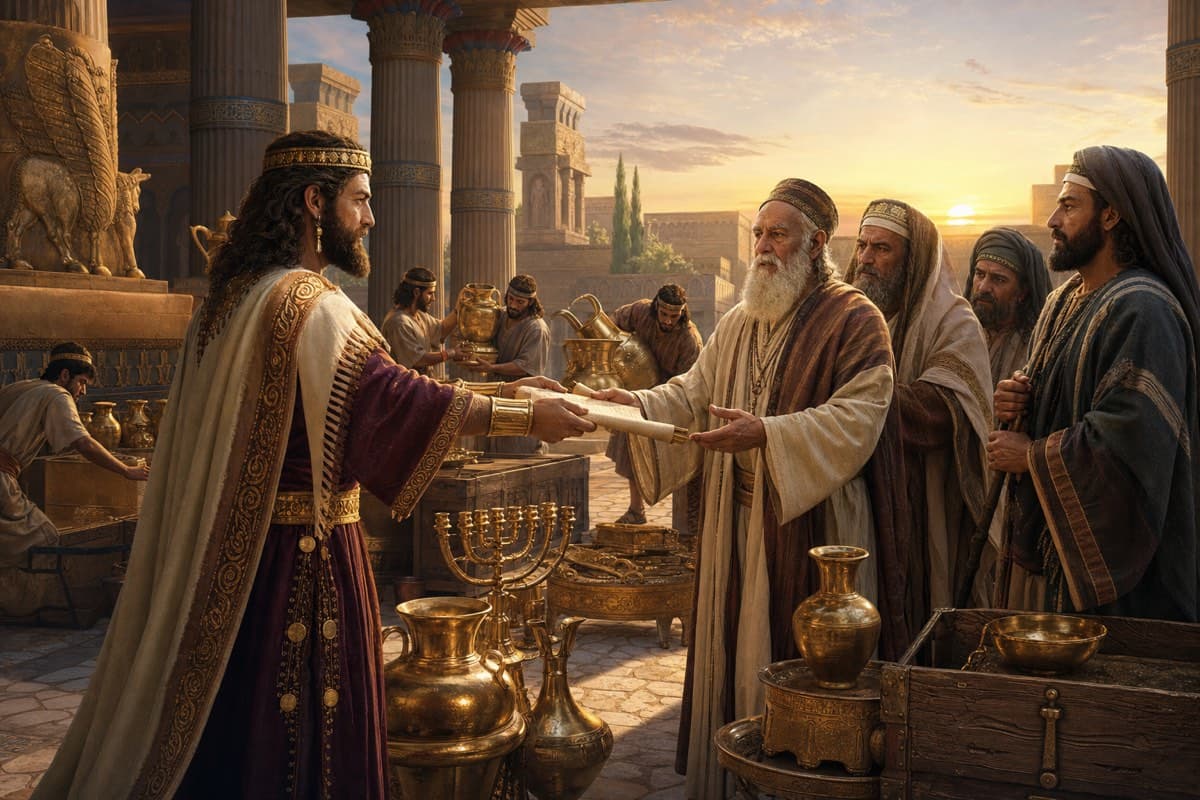
Ezra begins with an unexpected instrument in the Lord’s hand: Cyrus, king of Persia. The Jewish people had lived in exile for decades, Jerusalem lay damaged, and the temple had been destroyed. Yet the covenant God had not forgotten His people. He stirred Cyrus to permit their return, restore sacred vessels, and authorize the rebuilding of the house of the Lord. A powerful gentile ruler became part of fulfilling words spoken long before through Jeremiah and Isaiah.
The decree did not complete the restoration by itself. Families had to leave established lives, carry offerings, cross a long distance, and begin again amid ruins. God opened the way, and willing people still had to walk it. Their return reveals a recurring pattern in divine work: providence creates possibilities, revelation gives direction, and disciples answer through consecrated action.
This history broadens faith. The Lord’s purposes are not confined to people who already understand every doctrine or recognize His influence. He can move rulers, neighbors, institutions, and circumstances in ways that bless His covenant children. That truth does not make every political choice divine, but it does teach humility about the reach of God’s wisdom. He sees connections hidden from mortal sight.
Jesus Christ stands at the center of every true return. Through His Atonement, exile from God caused by sin need not be permanent. He restores what disciples cannot rebuild alone, returns holiness to ruined places, and invites willing hearts to rise. Hope grows as believers notice opened doors, receive unexpected help with gratitude, and then offer their own strength to the great work before them.
Questions to ponder and discuss
- Cyrus did not worship as an Israelite, yet the Lord stirred his heart to help fulfill prophecy. When have you seen God advance a good purpose through someone you did not expect?Ezra 1:1-4; Isaiah 44:24-28
- Some people returned to Jerusalem while others supported the work from where they were. What different but equally meaningful roles can people fill in the Lord's work today?Ezra 1:5-11
Tuesday, July 28
Joy at the House of the Lord
When the returned exiles laid the temple foundation, priests sounded trumpets, Levites played cymbals, and the people praised the Lord. The sound was not simple. Younger worshippers shouted for joy, while older people who remembered Solomon’s temple wept loudly. Their grief and gratitude rose together until observers could scarcely distinguish one from the other.
This scene honors the complexity of faithful emotion. Restoration does not require pretending that destruction never happened. The older generation remembered lost beauty, national collapse, and decades without the temple. Their tears did not cancel faith. The younger generation’s rejoicing was also true. God had given them a beginning, and a foundation was worthy of praise even before the building was complete.
Years later, the completed temple was dedicated with joy and Passover was kept. The structure was more modest than Solomon’s temple, but the Lord’s covenant presence could not be measured by architectural comparison. Sacred worship linked the people again to deliverance, sacrifice, remembrance, and hope.
The house of the Lord remains a place where Jesus Christ gathers grief and joy into redemption. Temple covenants do not erase mortality’s losses; they locate them inside His power to seal, cleanse, resurrect, and restore. Disciples can bring memories, longing, repentance, and gratitude to holy places. The Lord receives a sincere foundation and patiently builds upon it. Joy grows not from claiming that everything is already complete, but from recognizing that God has returned His people to covenant ground.
Questions to ponder and discuss
- The returning Jews restored the altar before the temple building was complete. What does their order of priorities teach us about beginning a spiritual rebuilding process?Ezra 3:1-6
- At the temple foundation, some people shouted for joy while others wept over what had been lost. How can a covenant community make room for gratitude and grief at the same time?Ezra 3:8-13
- What feeling comes to you when you think about the house of the Lord? What experience, hope, or covenant is connected to that feeling?Ezra 6:16-22
Wednesday, July 29
Prepare the Heart
Ezra appears as more than a scholar carrying information. He is a priest and skilled scribe whose life joins study, obedience, and teaching. Ezra 7 explains his influence with a revealing sequence: he prepared his heart to seek the law of the Lord, to do it, and to teach its statutes in Israel. His public ministry grew from a heart already turned toward God.
The order matters. Study without obedience can become pride, while action without careful learning can become misdirected zeal. Teaching without either may produce borrowed words with little spiritual power. Ezra lets revealed truth examine and shape him before he asks others to receive it. His competence is real, yet the record repeatedly credits “the good hand” of God for his favor, safe journey, and courage.
Scripture study is therefore both disciplined labor and covenant communion. The law of Moses gave the returned people a shared memory, moral order, sacrificial pattern, and witness of God’s holiness. After years among foreign powers, they needed more than walls and buildings. They needed hearts educated by revelation.
Jesus Christ is the living Word toward whom scripture points. Seeking the written word becomes transformative as the Holy Ghost reveals the Savior, leads to repentance, and forms Christlike action. Preparing the heart means approaching revelation with intent to follow, not merely to collect ideas. As disciples seek, do, and teach in that order, the Lord can place His hand upon ordinary study and turn it into strength for families, congregations, and generations.
Questions to ponder and discuss
- The temple project stalled when opposition became persistent and discouraging. What kinds of resistance most often weaken good efforts slowly rather than stopping them all at once?Ezra 4:1-6, 23-24
- Haggai and Zechariah helped the people begin again after a long pause. What kind of inspired reminder helps you return to a good work you have neglected or feared?Ezra 5:1-5
Thursday, July 30
Arise and Build
Nehemiah learned that Jerusalem’s wall was broken and its gates burned. Though he lived securely as cupbearer to the Persian king, the report pierced him. He sat down, wept, fasted, and prayed. His grief did not remain vague sorrow. In time it became a careful request, a dangerous journey, a nighttime inspection, and an invitation for the people to rise and build.
Nehemiah combines dependence on God with excellent preparation. He asks for letters, timber, time, and authority. After arriving, he quietly examines the damage before announcing a plan. Then he testifies of the good hand of God and the king’s favorable words. The people strengthen their hands for the work because honest assessment is joined to covenant hope.
The ruined wall represented exposure, shame, and a community unable to flourish safely. Rebuilding it was practical and spiritual. Yet Nehemiah never confuses stone with the true source of protection. The God of heaven prospers the work; the wall gives shape to faithful stewardship.
Jesus Christ teaches disciples to let holy sorrow mature into redemptive labor. He mourns with those who mourn and then strengthens hands to repair what can be repaired. Not every broken condition can be solved quickly, but careful service can still begin. Prayer clarifies motives, inspection replaces assumption with understanding, and testimony gathers willing people. Great work often starts when one person allows another’s pain to become personal enough to inspire faithful, organized action.
Questions to ponder and discuss
- Ezra prepared his heart to seek, do, and teach the Lord's law. Which of those three movements needs more attention in your discipleship right now?Ezra 7:6, 10
- Ezra repeatedly recognized "the hand of the Lord" in opportunities, safety, and courage. How can we acknowledge God's help without overlooking the preparation and effort He also asks of us?Ezra 7:9, 27-28
- Think of one gospel truth you understand better because you tried to live it. How did experience deepen what study alone had taught you?Ezra 7:10
Friday, July 31
A Mind to Work
As Jerusalem’s wall rose, opposition changed forms. Enemies mocked the builders, threatened violence, spread discouragement, and tried to divide attention. Nehemiah answered with prayer, watches, organized labor, and shared resolve. The people worked with tools while remaining prepared to defend one another. Their vigilance was not panic; it was disciplined unity.
Nehemiah 4 says the wall was joined because the people had “a mind to work.” The phrase describes more than enthusiasm. Families accepted assigned sections, carried burdens, watched for danger, listened for the trumpet, and continued despite fatigue. Purpose became communal. No single worker could protect or rebuild the whole city, but each could remain faithful to a portion while ready to support the rest.
Spiritual work also requires this combination of trust and wise action. Prayer is not a reason to ignore threats, and precaution is not proof of unbelief. Nehemiah prayed and set a watch. The Lord’s servants can seek revelation, establish safeguards, rest appropriately, use skilled help, and remain connected to the covenant community.
Jesus Christ creates a people capable of shared labor. His grace corrects both isolated self-sufficiency and passive dependence. Every disciple receives gifts, responsibilities, and a place in the body of Christ. When discouragement emphasizes rubble or mocks small progress, the Savior redirects attention to covenant purpose. A mind to work is formed as love becomes steadier than applause, service becomes more important than comparison, and each faithful stone is placed with confidence that the Lord remembers the whole wall.
Questions to ponder and discuss
- Nehemiah prayed, planned, inspected, and then invited others to build. What does his example teach about combining revelation with careful preparation?Nehemiah 2:4-18
- The builders had "a mind to work" even while facing ridicule and threats. What helps willingness become steady effort when a meaningful task is no longer new or exciting?Nehemiah 4:1-9
Saturday, August 1
I Cannot Come Down
When direct opposition failed to stop the wall, Nehemiah’s enemies tried distraction, slander, intimidation, and spiritual deception. Four times they invited him to meet on the plain of Ono. Nehemiah recognized that the invitation would pull him away from both safety and stewardship. His answer became a declaration of disciplined purpose: “I am doing a great work, so that I cannot come down.”
Focus here is not stubborn attachment to a personal project. Nehemiah remains prayerful, accountable, and responsive to real needs. What he refuses is manipulation designed to detach him from God’s assignment. He also resists a false report meant to frighten him and rejects counsel to hide unlawfully in the temple. Discernment matters because distraction can borrow the language of diplomacy, urgency, reputation, or even religion.
The wall was completed in fifty-two days, and surrounding nations perceived that the work had been accomplished by God. Nehemiah’s perseverance did not glorify personal efficiency; it made divine assistance visible to watchful neighboring peoples.
Jesus Christ gives disciples a purpose strong enough to order lesser demands. His covenant path does not eliminate competing voices, but it clarifies what deserves first loyalty. Saying no can become an act of consecration when it protects worship, family duty, integrity, or revealed service. Faithful focus is not frantic. It is the peaceful strength to remain where the Lord has placed the heart and hands, refusing to descend into distraction, fear, or compromise.
Questions to ponder and discuss
- Nehemiah's people built with one hand while keeping a weapon ready in the other. What spiritual practices help you remain productive without becoming careless about spiritual danger?Nehemiah 4:10-23
- Nehemiah answered repeated distractions with, "I am doing a great work, so that I cannot come down." What good work in your life deserves a clearer, more faithful no?Nehemiah 6:1-4
- After false accusations, intimidation, and betrayal, Nehemiah prayed, "Now therefore, O God, strengthen my hands." How might that prayer change the way you respond to pressure?Nehemiah 6:5-16
Sunday, August 2
Joy in Understanding
After the wall was built, the people gathered at the Water Gate and asked Ezra to bring the book of the law. Physical security was not the final goal. The restored community needed to hear God’s word, understand it, repent, worship, and become spiritually ordered from within.
Ezra read from morning until midday while men, women, and all who could understand listened attentively. Levites helped the people grasp the meaning. As the law exposed their distance from God, they wept. Yet the leaders told them the day was holy and directed them toward rejoicing, generous feasting, and care for those who had nothing prepared. “The joy of the Lord is your strength” did not deny sorrow for sin. It showed where godly sorrow should lead: toward covenant renewal and shared holiness rather than despair.
Understanding produced joy. The people were not merely moved by ceremony; they learned the words declared to them. Scripture became communal nourishment, crossing age and social lines and creating responsibility for neighbors.
Jesus Christ is the source of the joy toward which the law points. His Atonement turns recognition of sin into repentance, cleansing, and reconciled life. His gospel is understood not only with the mind but through obedient participation. As disciples listen carefully, receive help with difficult passages, honor prophetic interpretation, and act on revealed truth, the word builds an inner wall against deception. The week ends where restoration must always lead: a people gathered before God, strengthened by truth, holiness, generosity, and joy.
Questions to ponder and discuss
- The people listened attentively while Ezra read God's law. What can we do before and during scripture study to show the Lord that we genuinely want to hear Him?Nehemiah 8:1-8
- The people wept when they understood the law, but their leaders invited them to rejoice and share with those in need. How can godly sorrow lead us toward covenant joy instead of hopelessness?Nehemiah 8:9-12
These are supplemental study notes written by Rooted, an independent app not affiliated with The Church of Jesus Christ of Latter-day Saints. For the official lesson, see Come, Follow Me on churchofjesuschrist.org.