
Our Eyes Are upon Thee
2 Chronicles 14-20; 26; 30 · July 20–26, 2026
Judah's kings reveal the peace of trusting God, the courage of truth, the danger of pride, and the healing power of covenant worship.
Monday, July 20
Trust That Endures
Asa's story begins with the quiet strength of a king who seeks the Lord. He removes idolatrous places, calls Judah to covenant faithfulness, and uses years of peace to strengthen the cities. When a vast army advances against him, Asa does not pretend that Judah's forces are sufficient. He cries to the Lord, confessing that divine help is not limited by human numbers. The victory that follows teaches that peace is more than the absence of conflict. It grows from placing confidence in the God who is present before, during, and after a crisis.
The later chapters make Asa's example more searching. When threatened by Baasha, he takes treasure from the temple and purchases Syria's support rather than seeking the Lord. When the prophet Hanani exposes this change, Asa becomes angry and oppressive. Near the end of his life, his diseased feet become another occasion when the record says he sought physicians instead of the Lord. The point is not that planning, allies, or medical care are inherently faithless. Scripture repeatedly honors wisdom and healing. Asa's tragedy is that useful means became substitutes for dependence on God.
Trust must therefore become a relationship rather than a technique for obtaining a preferred result. Earlier deliverance did not eliminate Asa's need to keep seeking. Past spiritual strength does not automatically govern present choices. Disciples remain spiritually safe as they remember who gave the strength, repent when self-reliance hardens, and bring every available resource under the Lord's direction.
Jesus Christ makes enduring trust possible. Through Him, weakness can become a place of communion instead of shame. His grace teaches disciples to work diligently without worshipping their own preparation and to receive help without forgetting its source. Peace comes as the heart stays near the Father and the Son, whether deliverance arrives quickly or faith must continue through a long and refining season.
Questions to ponder and discuss
- Asa admitted that Judah could not win by numbers alone. Where in your life would an honest acknowledgment of your limits help you rely more fully on the Lord?2 Chronicles 14:9-12
- Azariah told Asa, "Be ye strong therefore, and let not your hands be weak." What kind of spiritual work can feel tiring even when you know it matters? What helps you keep going?2 Chronicles 15:1-8
Tuesday, July 21
Speak What God Gives
Micaiah enters a scene built to reward agreement. Two kings sit in royal robes near Samaria's gate. Hundreds of prophets promise success, one even using iron horns as a dramatic sign of victory. The messenger sent to bring Micaiah does not ask him to discover the Lord's will. He asks him to make his message match everyone else's. Micaiah's answer establishes the center of prophetic integrity: he will speak what God gives him.
His first response to Ahab is sarcastic, echoing the approved prediction so plainly that the king recognizes it as insincere. Micaiah then delivers the unwelcome vision of Israel scattered without a shepherd. Ahab hears correction as personal hostility, and a court prophet strikes Micaiah. The king imprisons him on meager rations. Truth does not become popular merely because it is spoken clearly, and courage does not guarantee immediate vindication.
Micaiah's example is not permission for harshness or a claim that every unpopular opinion is inspired. His authority comes from submitting his own words to the Lord. Christian courage joins conviction with humility, accuracy, and love. It refuses both the flattery that protects status and the pride that enjoys provocation. Disciples seek the Holy Ghost, honor living prophets, study revealed doctrine, and speak in ways that reflect the character of Jesus Christ.
The Savior Himself stood before rulers, endured false witness, and testified of truth without surrendering charity. Because He conquered sin and death, disciples need not make social approval their source of safety. They can be patient when misunderstood, willing to revise personal assumptions, and firm when revelation is clear. Integrity means that allegiance to God quietly governs words even when a crowd has already decided what it wants to hear.
Questions to ponder and discuss
- Why might someone who has trusted the Lord in one crisis still lean mainly on human solutions in the next one? What can Asa's change of heart teach us about lifelong faith?2 Chronicles 16:1-10
- Asa sought physicians but did not seek the Lord. How can we use competent professional help while still making God central to healing, decision-making, and hope?2 Chronicles 16:11-13
- Think of a time when a practical solution worked but still did not bring peace. What was missing, and what might it look like to put your eyes on the Lord now?2 Chronicles 16:7-9
Wednesday, July 22
Our Eyes Are upon Thee
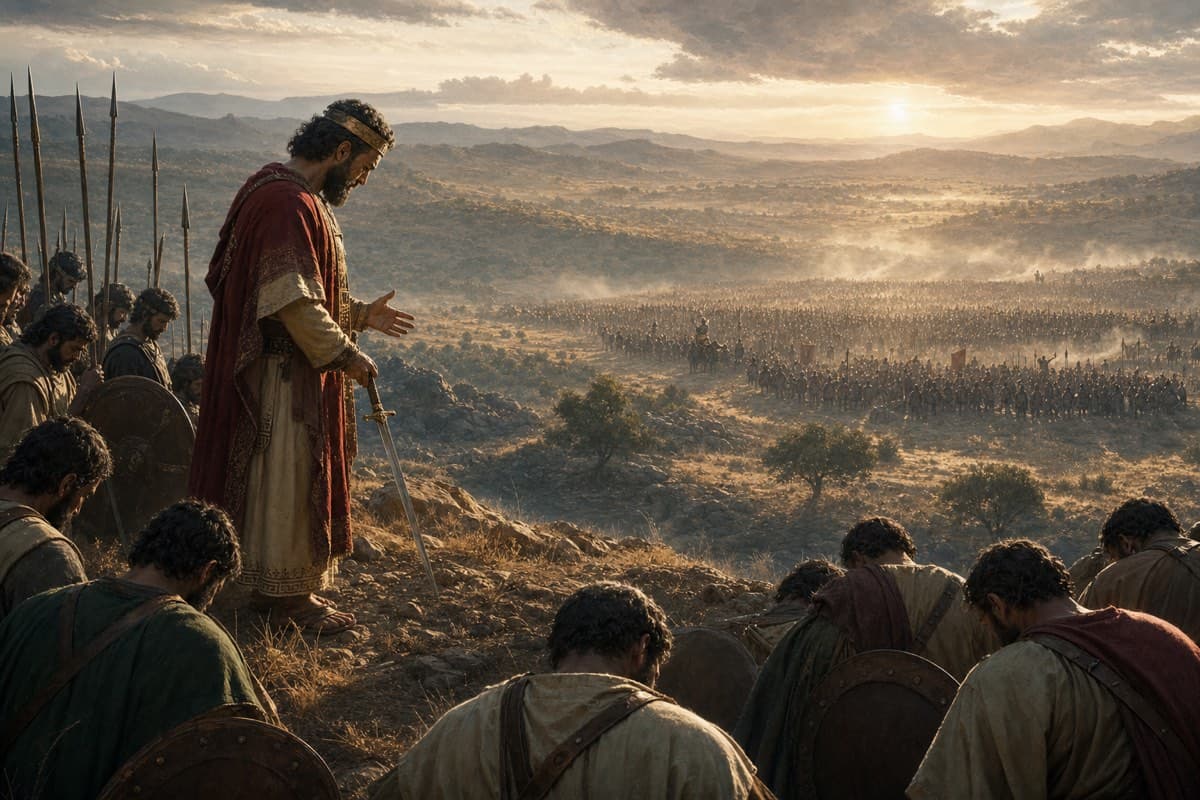
When several nations advance against Judah, Jehoshaphat is afraid. Scripture does not hide that first emotion, nor does it treat fear as his final spiritual identity. The king sets himself to seek the Lord, proclaims a fast, and gathers the people at the temple. His fear becomes the beginning of worship rather than the master of his decisions.
Jehoshaphat's prayer remembers who God is, what He has done, and what He has promised. He names the threat honestly and admits that Judah has neither sufficient power nor a clear strategy. Then comes the line that gives the week its title: “our eyes are upon thee.” This is not resignation. It is focused dependence. The people remain assembled, including families and little children, waiting for the Lord's word. Through Jahaziel, the Spirit promises that the battle belongs to God and commands them not to fear or be dismayed.
Many disciples recognize the spiritual geography of this scene. A diagnosis, fractured relationship, temptation, family burden, or uncertain future can feel like several armies arriving at once. Prayer may begin without a solution. Jehoshaphat shows that not knowing what to do can be confessed without surrendering faith. Worship turns the eyes from endless measurement of the threat toward the character and covenant of God.
Jesus Christ is the reason such looking can become hope. He entered mortal helplessness, bore the full weight of sin and death, and rose victorious. His victory does not mean every conflict ends immediately, but it means no faithful person faces adversity outside His redeeming reach. When disciples cannot see the path, they can still orient the heart toward Him, receive the next revealed step, and stand in holy places with a covenant community. Peace begins before the battlefield changes because the direction of the soul has changed.
Questions to ponder and discuss
- Micaiah was urged to agree with hundreds of reassuring voices. What makes an idea feel true merely because it is popular, repeated, or convenient? How can we recognize truth more reliably?2 Chronicles 18:1-13
- Micaiah told the truth even though he was struck and imprisoned. What helps a person defend truth without becoming proud, combative, or eager to embarrass others?2 Chronicles 18:13-27
Thursday, July 23
Praise before the Answer
The morning after Jehoshaphat's prayer, Judah walks toward the wilderness of Tekoa. The people have received a promise, but they have not yet seen its fulfillment. At this threshold Jehoshaphat calls them to believe in the Lord and His prophets. Then singers are appointed to go before the army, praising the beauty of holiness and declaring the endurance of God's mercy. Worship leads the procession into uncertainty.
The sequence matters. They do not wait until the battlefield is safe to begin praising. Their song is an act of trust offered while the enemy remains ahead. As they praise, the attacking coalition collapses into conflict with itself. Judah discovers that the Lord has fought the battle, gathers the spoil, blesses God in the valley of Berachah, and returns to Jerusalem with music and joy. The surrounding kingdoms hear of the deliverance, and Jehoshaphat's realm receives rest.
Praise is not denial or an attempt to force a miracle. In Christian worship, gratitude names what is eternally true before every temporary condition is resolved. God is good, His mercy endures, Jesus Christ has atoned and risen, covenants remain available, and the Holy Ghost can sustain the faithful. Singing these truths helps the body and memory participate in belief. It also joins individual courage to the strength of a covenant people.
Living prophets perform a related work. They testify of Christ, warn, invite repentance, and help the Saints interpret dangerous terrain through revelation. Believing prophets does not replace a personal witness or moral agency; it calls disciples to seek confirmation, act faithfully, and let revealed truth shape decisions. Jehoshaphat's procession portrays a mature order of trust: hear the Lord, receive prophetic direction, move forward, and praise before sight. Through the Savior, worship can become courage in motion.
Questions to ponder and discuss
- Jehoshaphat prayed, "Neither know we what to do: but our eyes are upon thee." Which part is harder for you: admitting you do not know, or continuing to look to God while you wait?2 Chronicles 20:1-12
- The Lord said, "The battle is not yours, but God's," yet the people still had to go forward the next morning. How do we tell the difference between faithfully acting and anxiously trying to control everything?2 Chronicles 20:13-17
- Choose one short phrase from Jehoshaphat's prayer or Jahaziel's answer that you would want beside you in a difficult moment. Why does that phrase matter to you?2 Chronicles 20:6-12, 15-17
Friday, July 24
Strong Enough to Be Humble
Uzziah's reign is filled with accomplishment. He begins as a young king who seeks God. He succeeds in war, strengthens Jerusalem, digs wells, supports agriculture, organizes a large army, and commissions ingenious defenses. The chronicler repeatedly explains his strength as divine help. Then one sentence marks the turning point: when Uzziah became strong, his heart was lifted up to his destruction.
The king enters the temple to burn incense, a sacred service assigned to consecrated priests. Azariah and eighty courageous priests oppose him. Their resistance is not rebellion against legitimate government; it is loyalty to the boundaries God established for worship. Uzziah responds with anger rather than humility. His disease becomes visible at the altar, and he spends the rest of his life separated from both the temple and ordinary royal life. The man who tried to enlarge his role loses access to what pride treated casually.
Pride often grows by rewriting the source of strength. Gifts become evidence of superiority, stewardship becomes ownership, and success creates a sense that ordinary commandments no longer apply. Uzziah's story exposes that movement before it appears dramatic. Every ability remains a gift to be consecrated. Divine callings carry real authority, but they also have revealed boundaries. The Lord's house is governed by priesthood order, not by status, talent, or impatience.
Jesus Christ offers a different pattern of power. Though possessing all authority, He submitted perfectly to the Father, served, washed feet, and completed the Atonement. His humility was not weakness; it was strength fully aligned with holy love. Disciples become safer as they receive correction, honor others' stewardships, and remember the Giver during seasons of success. The strongest heart is not the one that needs no limits. It is the one humble enough to remain teachable when praise, influence, or achievement could make self-importance feel deserved.
Questions to ponder and discuss
- Jehoshaphat put singers in front of the army before the outcome was visible. How can worship change the way we enter a hard situation, even before the situation itself changes?2 Chronicles 20:18-23
- After deliverance, Judah returned to the temple with joy. What helps you remember, share, and worship after receiving an answer instead of simply moving on to the next concern?2 Chronicles 20:24-30
Saturday, July 25
An Invitation across the Divide
Hezekiah inherits a divided religious world. The northern kingdom and Judah have lived as rivals, temple worship has been neglected, and Assyria has devastated much of Israel. Yet Hezekiah sends couriers from Beersheba to Dan, inviting all Israel to come to Jerusalem for Passover. His message does not deny the people's rebellion or its consequences. It calls the remnant to turn again to the Lord, confident that God is gracious and merciful.
The response is mixed. Some people laugh the couriers to scorn. Others from Asher, Manasseh, and Zebulun humble themselves and come. Judah is given one heart to accept the king's plan. Peacemaking here is neither vague friendliness nor avoidance of covenant truth. It is an invitation to return together to the God of their fathers. Hezekiah uses his influence to open a path back rather than deepen an old rivalry.
The Passover itself remembers deliverance from bondage through the blood of the lamb. For Christians, it also points toward Jesus Christ, the Lamb of God, whose sacrifice creates reconciliation with God and makes a new covenant people. Hezekiah's broad invitation therefore anticipates the gathering work of the Savior. People separated by history, geography, failure, and suspicion can be invited toward one holy center.
Disciples act as peacemakers when they create faithful ways for people to return, participate, and belong. Some invitations may be mocked, and others may be received only after long delay. The outcome does not cancel the holiness of reaching out. Invitations become Christlike as they combine clarity about repentance with patience, generosity, and respect for agency. The gospel does not ask Saints to win every response. It asks them to carry the message of reconciliation without contempt and to prepare a community ready to welcome those who come.
Questions to ponder and discuss
- Uzziah was helped "till he was strong," but his strength eventually fed his pride. Why can success become a more subtle spiritual test than failure?2 Chronicles 26:3-16
- The priests resisted Uzziah even though he was powerful and angry. What can their example teach us about honoring both authority and God-given boundaries?2 Chronicles 26:16-21
Sunday, July 26
The Lord Healed the People
The gathered Passover includes many worshippers who are not ritually prepared according to the usual pattern. Levites assist them, and Hezekiah prays that the good Lord will pardon everyone who has prepared the heart to seek God. The Lord hears and heals the people. This scene holds order and mercy together. The king does not declare preparation irrelevant; he intercedes for sincere people whose return is still incomplete.
The result is not a hurried, embarrassed observance. Jerusalem experiences great gladness. Levites teach the good knowledge of the Lord, the people confess and offer peace offerings, leaders give generously, and the entire assembly chooses to continue for another seven days. Judahites, northern Israelites, and strangers rejoice together. Priests bless the people, and their prayer is heard in heaven. A community once divided becomes a community of worship.
Hezekiah's response models peacemaking grounded in Jesus Christ. A peacemaker does not merely suppress disagreement. A peacemaker helps people move from estrangement toward truth, repentance, healing, and shared joy. That work requires invitation, patience with imperfect beginnings, clear teaching, intercession, generosity, and a willingness to treat returning people as brothers and sisters rather than permanent outsiders.
The Savior is the true source of this peace. His Atonement satisfies justice and extends mercy to all who turn toward Him. He can purify what remains unclean, heal the wounds created by sin and division, and make covenant unity possible without erasing individual history. Followers of Christ therefore reject contempt and harshness, including in ordinary communication. They speak truth in ways that keep the door to repentance and reconciliation open. Like Hezekiah, they pray for others, honor sincere desire, and help create holy gatherings where the Lord's healing can turn a tentative return into enduring joy.
Questions to ponder and discuss
- Hezekiah invited people across old political and family divisions to return to the Lord together. What makes an invitation a genuine act of peacemaking rather than pressure or self-promotion?2 Chronicles 30:1-12
- Some worshippers arrived sincerely but unprepared, and Hezekiah prayed for mercy on their behalf. How can we uphold sacred standards while helping imperfect people come closer to Jesus Christ?2 Chronicles 30:13-20
- The people chose to continue their joyful worship for another seven days. What would help Sabbath worship and covenant renewal feel more like a gift you want to linger in than an obligation to finish?2 Chronicles 30:21-27
These are supplemental study notes written by Rooted, an independent app not affiliated with The Church of Jesus Christ of Latter-day Saints. For the official lesson, see Come, Follow Me on churchofjesuschrist.org.