
The Battle Is the Lord's
1 Samuel 17-18; 1 Samuel 24-26; 2 Samuel 5-7 · June 15–21, 2026
Faith, restraint, covenant friendship, and divine kingship in the rise of David.
Monday, June 15
The Battle Is the Lord's
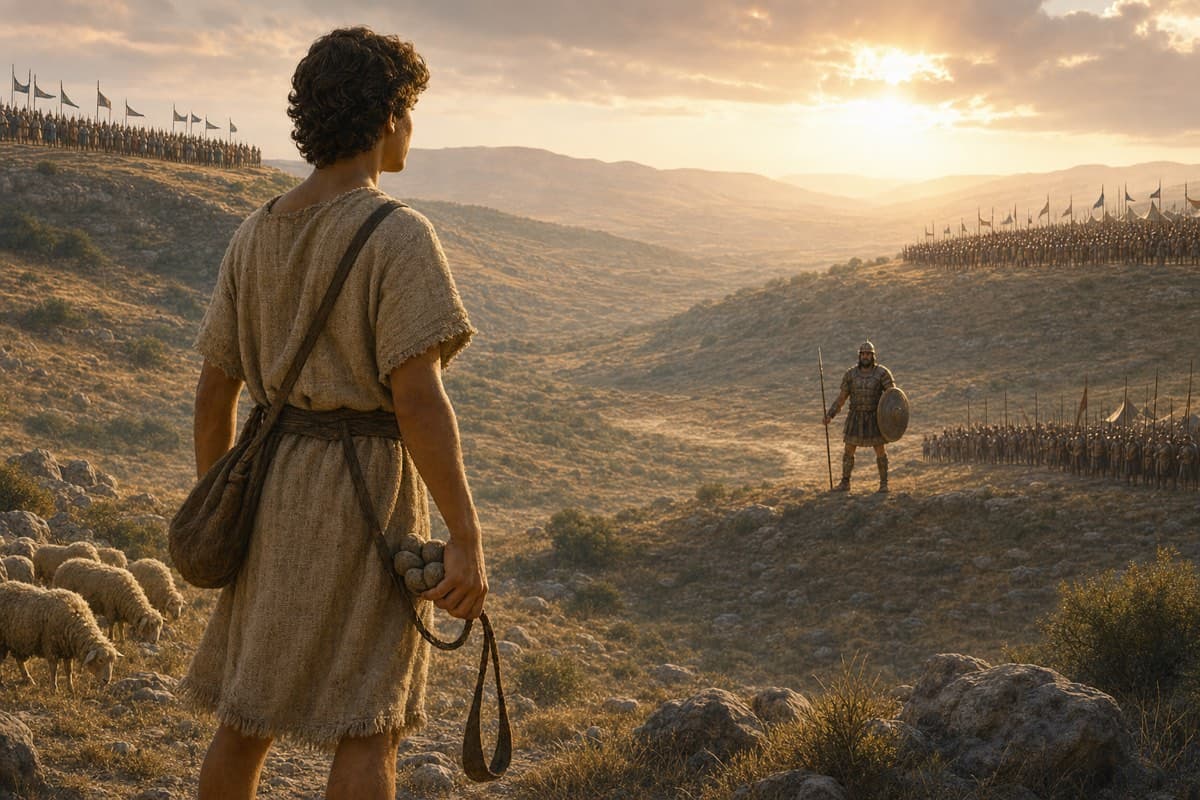
David entered the valley of Elah with a memory Saul and Israel had temporarily lost: the Lord had already been Israel's deliverer. Goliath's size, armor, and speech filled the scene so completely that the army measured the conflict by visible strength. David measured it by covenant. He remembered the lion and the bear, not as stories about his own skill, but as evidence that the Lord knew how to save. That memory changed the meaning of the present danger. Goliath was still real, and David still had to walk forward, but the battle no longer belonged to fear.
The contrast in 1 Samuel 17 is not merely between a giant and a shepherd. It is between two ways of seeing. Goliath sees rank, weapons, and intimidation. Eliab sees presumption in his younger brother. Saul sees inexperience. David sees the living God and an uncircumcised Philistine defying the armies of that God. Faith does not erase details. David knows what a predator can do, what a sword can do, and what a spear can do. Yet he also knows what deliverance feels like when the Lord has been present in ordinary wilderness work before the public crisis arrives.
The phrase "the battle is the Lord's" teaches a disciplined kind of courage. David does not stand still and demand that heaven act while he watches. He chooses a familiar sling, runs toward the army, and acts with practiced skill. Faith sanctifies preparation rather than replacing it. The Lord's power meets David in the form David can faithfully offer. In every generation, disciples face visible forces that seem too large for personal faith. David's witness is that covenant memory, humble preparation, and trust in the living God can move a person forward when fear has frozen everyone else.
Tuesday, June 16
Five Smooth Stones
David's victory began before the stone left the sling. It began in the fields, where a young shepherd learned courage by protecting sheep, praying through danger, and trusting the Lord without applause. When the moment came, David did not borrow Saul's armor simply because it was the approved equipment of a king. He tried it, recognized that it did not fit, and laid it aside. Faith can include the humility to use what the Lord has actually helped a person learn.
The five stones in David's pouch invite reflection on the small, repeatable sources of spiritual strength that become powerful when consecrated. A stone is ordinary. In David's hand, with the Lord's help, it becomes enough. The same pattern appears across discipleship. Prayer, scripture, covenants, service, repentance, inspired relationships, and remembered deliverance may seem small beside the scale of modern problems. Yet the Lord often works through faithful, familiar means rather than through impressive displays.
David's individual faith also matters for a whole people. Israel's army had accepted a paralyzing story: no one could answer the giant. David brought a different story into the camp, one rooted in the living God. One faithful disciple cannot solve every problem alone, but one person acting with covenant trust can interrupt despair, reveal another possibility, and invite others to remember the Lord. The stone that struck Goliath was small, but the witness behind it was large enough to awaken an army. That witness still teaches ordinary disciples to gather the small holy things that keep courage close at hand.
Wednesday, June 17
Jonathan's Covenant Friendship
After David's victory, the story turns from battlefield courage to the quieter miracle of covenant friendship. Jonathan had every worldly reason to see David as a threat. As Saul's son, he might have imagined the throne as his inheritance. Instead, he loves David "as his own soul" and gives him robe, garments, sword, bow, and belt. These gifts are not casual tokens. They are signs that Jonathan can rejoice in God's purposes even when those purposes seem to rearrange his own future.
Saul and Jonathan become a sharp contrast. Saul hears the women's song about David and becomes suspicious, angry, and afraid. Jonathan sees David's rise and chooses loyalty, generosity, and spiritual kinship. The difference is not simply personality. It is whether another person's gifts are received as evidence of God's goodness or as an injury to one's own importance. Saul's jealousy narrows his world until David's success feels like Saul's loss. Jonathan's love expands his world until David's calling can be honored without self-protection.
Jonathan's friendship points toward Jesus Christ because it is covenantal, self-giving, and loyal at cost. He gives what symbolizes his status and strength. He intercedes for David before Saul. He warns and protects David when danger grows. Christ's love is infinitely greater, but Jonathan helps readers recognize the beauty of love that does not compete with God's will. Holy friendship rejoices in another person's divine calling and helps that person live it. Such friendship becomes a quiet school for charity.
Thursday, June 18
Mercy in the Cave
1 Samuel 24 places David in a cave with the opportunity to end years of fear. Saul has hunted him unjustly. David's men interpret Saul's vulnerability as providence: the enemy has been delivered into David's hand. Their interpretation sounds religious, but David refuses to baptize revenge as revelation. He cuts Saul's robe and even that troubles his heart. The scene teaches that opportunity alone does not prove permission. A disciple still has to ask what kind of action reflects reverence for the Lord.
David's restraint is not weakness. He names Saul's wrongdoing, shows evidence that he could have killed him, and appeals to the Lord as judge. Mercy does not require pretending that evil is good. It means surrendering vengeance to God and refusing to become unrighteous in the process of resisting unrighteousness. David's refusal to kill Saul protects David's soul as much as Saul's life. He will not seize the kingdom by the same violence and fear that have corrupted Saul.
This day also invites attention to emotional poise. David's circumstances are extreme, but the spiritual principle is ordinary. People often face moments when resentment, embarrassment, or injury creates a chance to strike back. Christlike restraint asks whether the desired response will increase holiness or merely satisfy wounded pride. In the cave, David lets the Lord govern both timing and judgment. That surrender becomes a form of peace before circumstances are fully resolved. It is one of the ways faith keeps power from becoming revenge.
Friday, June 19
Abigail and the Healing Path
1 Samuel 25 adds Abigail to the story of David's formation. Nabal's insult enrages David, and David prepares to answer contempt with bloodshed. The danger is subtle because David has just shown mercy to Saul. A person can pass one spiritual test and still be vulnerable to another. David refuses to kill the king in a cave, but he nearly destroys a household over humiliation. Abigail's wisdom interrupts that descent.
Abigail acts quickly, generously, and truthfully. She brings food, bows before David, names Nabal's folly without defending it, and reminds David of the Lord's promises. Her speech does not flatter David's anger. It calls him back to his better covenant future. She helps him see that vengeance would become a grief and offense of heart when the Lord establishes him. In that sense Abigail is a peacemaker who protects both her household and David's conscience.
The chapter teaches that forgiveness and restraint are often communal gifts. David needed Abigail's inspired intervention. Disciples also need people who can step into heated moments with courage, humility, and truth. Abigail's Christlike pattern is not identical to the Savior's atonement, but it reflects His work of intercession and healing. She moves toward danger to prevent needless bloodshed. She offers a way out of wrath. She helps David receive correction as mercy. Her story honors peacemakers who arrive before damage becomes permanent. It also honors the humility of those who let themselves be stopped spiritually.
Saturday, June 20
Inquiring of the Lord
When David becomes king, the Philistine threat does not disappear. Public calling does not remove opposition, and past victories do not provide a permanent strategy for every future battle. In 2 Samuel 5, David repeatedly inquires of the Lord. He asks whether to go up against the Philistines, and later, when the enemy returns, he receives different instructions. The Lord tells him not to go straight up, but to circle behind and wait for a sign in the mulberry trees. Revelation is living guidance, not merely a memory of what worked before.
David's example is striking because he has real military experience. He defeated Goliath, survived wilderness conflict, led men in battle, and now reigns as king. Yet experience does not make him spiritually self-sufficient. He still asks. His kingship is strongest when it is dependent on the Lord. The chapter connects authority with humility: the king of Israel must remain a servant who seeks divine direction.
The repeated inquiry also teaches patience. David does not treat revelation as a vague endorsement of his preferred plan. He receives specific direction and acts accordingly. Sometimes the Lord's guidance is advance, and sometimes it is wait. Sometimes the instruction resembles previous experience, and sometimes it requires a new route. Disciples are blessed when they resist the temptation to turn yesterday's answer into today's assumption. The Lord can direct both the battle and the timing. The mature disciple learns to ask again with real intent.
Sunday, June 21
A House That Lasts Forever
2 Samuel 7 moves from battles to covenant promise. David, settled in his house of cedar, wants to build a house for the Lord. The desire seems reverent, and Nathan first approves it. But the word of the Lord redirects the plan. David will not build the temple. His son will. More importantly, the Lord promises to build David a house, meaning a dynasty, and declares that David's throne will be established forever.
The reversal is full of grace. David wants to give God a house, but the Lord reminds David that every good thing in his life has come from divine initiative. The Lord took him from following sheep, made him ruler, cut off enemies, and made him a name. Before David can build anything for God, he must receive what God is building through him. Covenant begins with the Lord's generosity, not human achievement.
Latter-day Saints read the promise to David in light of Jesus Christ. Earthly kings fail, kingdoms fracture, and David himself will later sin grievously. Yet the Lord's covenant points forward to an Eternal King, descended from David, whose reign has no end. Jesus Christ fulfills the hope that no mortal monarch could carry completely. The house promised to David becomes a witness that the Lord can work through history, family lines, prophetic promises, and even flawed people to bring about redemption in the Son of God. Covenant promise is steadier than mortal glory and stronger than human failure.
These are supplemental study notes written by Rooted, an independent app not affiliated with The Church of Jesus Christ of Latter-day Saints. For the official lesson, see Come, Follow Me on churchofjesuschrist.org.