
A New Spirit Will I Put within You
Ezekiel 1–3; 33–34; 36–37; 47 · November 2–8, 2026
Covenant hope, thoughtful discipleship, and the Lord’s restoring care.
Monday, November 2
The Lord meets people in exile
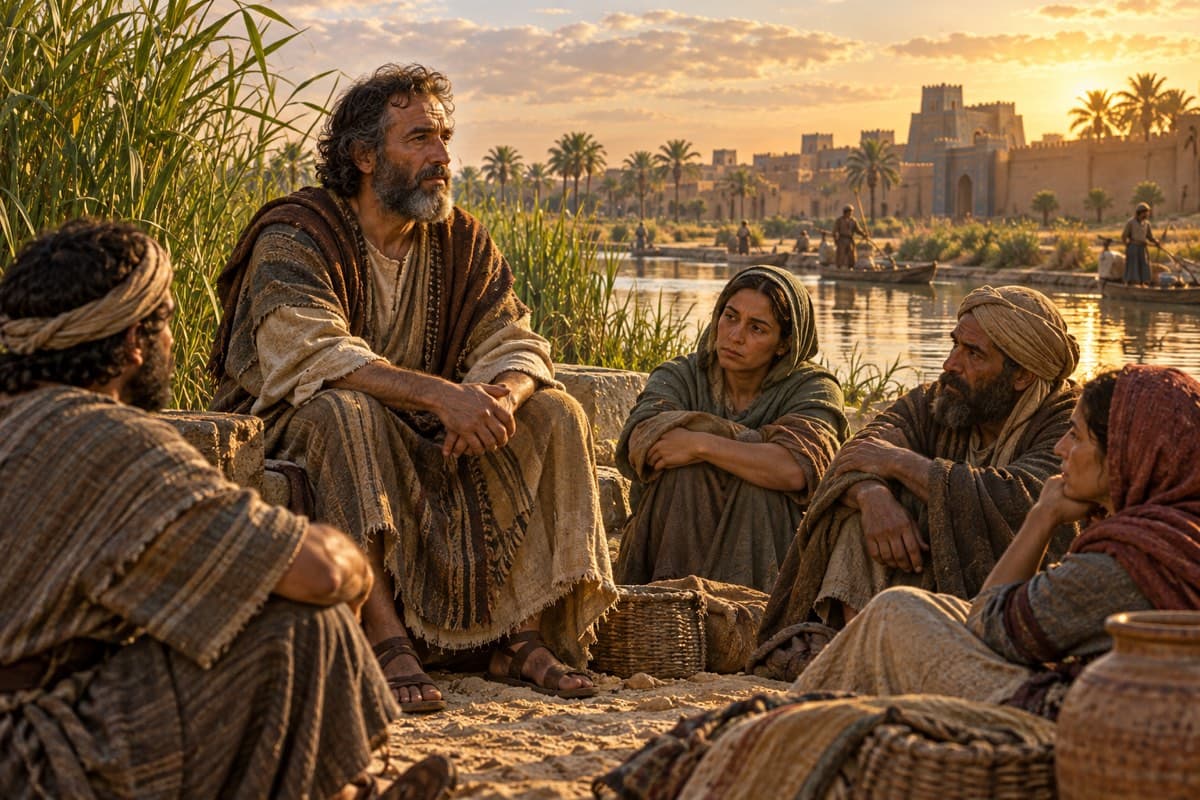
Ezekiel's opening vision takes place among captives by the river Chebar. The text identifies him as a priest, but the revelation comes far from Jerusalem. This location is a major part of the account's meaning. Exile has changed the people's circumstances profoundly, yet it has not placed them beyond the reach of the Lord's word. The prophet encounters divine glory in the place where the displaced community actually lives.
The vision is difficult to picture. Ezekiel repeatedly uses language of appearance and likeness as he describes living creatures, wheels, brightness, and a throne. Readers need not claim certainty about every visual detail to notice the account's central movement: the Lord makes Himself known, and Ezekiel is called to hear and speak. Reverence can include acknowledging the limits of one's understanding of a vision.
The call includes a warning to Ezekiel himself not to become rebellious. Before delivering God's words to others, he must receive them. The image of eating the scroll makes that receiving unusually vivid. The message must enter his own life; it cannot remain only material he passes along. Its sweetness does not mean that the assignment will be emotionally easy, since the following account describes bitterness and astonishment.
When Ezekiel comes to the exiles at Tel-abib, he sits among them for seven days. The text does not spell out everything he learns or thinks during that time. It does show him sharing their location before the next word from the Lord comes. This gives a grounded image for attentive ministry: people are more than an audience waiting for advice. They have a place, a history, and a burden. In Latter-day Saint discipleship, teaching by the Spirit can be joined with patient presence and a willingness to hear before speaking.
Questions to ponder and discuss
- Ezekiel spends seven days sitting among people who have been forced from their homes before the next message comes. What can someone learn by staying with people before trying to advise them?Ezekiel 1:1-3; Ezekiel 3:10-16
- Ezekiel receives God’s word far from the temple and his homeland. What helps you feel less alone somewhere you do not feel you belong?Ezekiel 1:1-3; Ezekiel 3:10-15
Tuesday, November 3
A warning that leaves room to choose
The Lord describes Ezekiel as a watchman. A watchman's task is to notice danger and sound the warning so that people can respond. Ezekiel 33 develops the image by distinguishing the responsibility to give the alarm from the responsibility to heed it. The watchman cannot choose for every hearer, but he is accountable for failing to communicate a warning entrusted to him.
The metaphor gives prophetic teaching both seriousness and limits. Ezekiel must hear the word from the Lord and warn the people from Him. His authority in this account is not simply a claim to be more anxious or more perceptive than everyone else. It is a divine commission with a specific source. The message serves life: the warning is given so that people may turn from danger.
The distinction between warning and controlling is especially important in ordinary relationships. A parent, friend, or leader may have a responsibility to speak clearly about a real concern. That responsibility does not create unlimited authority over another person's decisions. Nor does a loved one's refusal prove that the speaker should have used more pressure. The text distinguishes faithful delivery from the hearer's response.
Latter-day Saints recognize the continuing importance of prophetic warnings. Receiving them thoughtfully includes listening, seeking understanding, and considering what conduct needs to change. The image also applies to the messenger's humility. Ezekiel has already been told to receive the Lord's words in his own heart. A warning is not a position from which to look down on others. It is a form of accountable service. The watchman's success is not applause, and the hearer's responsibility is not merely to admire the sound of the alarm. The purpose is a truthful opportunity to respond to danger while response remains possible.
Questions to ponder and discuss
- Ezekiel’s watchman sounds the alarm but cannot choose for the people. What is the difference between giving a clear warning and trying to control someone?Ezekiel 3:17-19; Ezekiel 33:1-9
- Ezekiel describes a watchman warning of danger ahead. When has advice made more sense to you later than it did at first?Ezekiel 3:17-19; Ezekiel 33:1-9
- Ezekiel is told to pass on the warning he receives from the Lord. What helps someone admit that a warning applies to them too?Ezekiel 3:17-19; Ezekiel 33:1-9
Wednesday, November 4
Repentance opens a future
The people in Ezekiel 33 describe themselves as wasting away under the weight of their wrongdoing. Their question is whether life is still possible. The Lord answers with an emphatic declaration that He does not delight in the death of the wicked. His invitation is to turn and live. The warning's purpose is therefore inseparable from the offer of a future.
The passage refuses two opposite ways of treating the past as destiny. A history of righteousness does not provide permission to do wrong now. A history of wrongdoing does not make sincere repentance meaningless. The Lord addresses what a person turns toward and does. Past labels do not remove present responsibility or close the possibility of mercy.
Repentance receives concrete description. The person returns a pledge, gives back what was stolen, and walks in the ways of life. These actions reach beyond private regret to the treatment of other people. The text does not imply that every injury can be fully undone. It does show that turning toward God includes taking seriously what one's actions have cost someone else.
In Latter-day Saint belief, repentance is made possible through Jesus Christ and His Atonement. It is not a technique for earning divine indifference to sin. It is a return to the Savior that involves faith, changed conduct, and the acceptance of mercy. Practical repair may take time, and the person harmed is not required to restore trust immediately. Ezekiel's promise of life gives the wrongdoer a reason to change without demanding that others pretend nothing happened. The chapter offers both hope and accountability: no reputation licenses harm, and no honest return needs to be dismissed merely because the past was painful.
Questions to ponder and discuss
- Ezekiel describes repentance as returning what was taken, not only feeling sorry. What can make an apology believable to the person who was hurt?Ezekiel 33:10-16
- Ezekiel warns against relying on past righteousness while doing wrong now. Why can a good reputation make it harder to notice that we need to change?Ezekiel 33:10-16
Thursday, November 5
The Shepherd notices what each sheep needs
Ezekiel 34 condemns shepherds who feed themselves while neglecting the flock. The image exposes leadership that uses people rather than caring for them. The Lord names specific failures: the weak have not been strengthened, the sick have not been healed, the injured have not been bound up, and the scattered have not been sought. Force and cruelty have replaced care.
The Lord then promises to seek His sheep Himself. He will gather, feed, give rest, bind up injuries, and strengthen the sick. These verbs give divine care a varied shape. The flock is not treated as though every sheep has the same need. The distinction between the lost and those driven away also matters. Scattering can involve the actions of others, and an account of belonging should not place all blame on the absent person.
The chapter's judgment reaches beyond shepherds to sheep that spoil the pasture and muddy the water. Strong sheep push weaker ones aside. This widens the moral responsibility within the flock. Harmful community life is not only a matter of formal leadership; ordinary members can make resources and belonging harder for others to reach.
The promise of one shepherd, identified with the Lord's servant David, points Christian readers toward the Messiah, Jesus Christ. His care provides the center and measure of faithful ministry. For Latter-day Saints, ministering is therefore more than completing a contact or delivering identical advice. It involves learning what is needed and responding with respect. The passage's pastoral image should not be used to infantilize adults or disregard their choices. Its force is that entrusted care must serve the people cared for. Food, rest, healing, protection, and gathering are different gifts, and love pays attention to which gift is needed.
Questions to ponder and discuss
- Ezekiel names sheep that are lost and sheep that have been driven away. How might that difference change the way someone offers help?Ezekiel 34:4, 11-22
- In Ezekiel’s picture, strong sheep muddy the water that others must drink. What is an everyday way a group can make life harder for quieter members without noticing?Ezekiel 34:4, 11-22
- The shepherd in Ezekiel notices whether a sheep needs food, rest, or care for an injury. What helps us find out what kind of help someone actually wants?Ezekiel 34:4, 11-22
Friday, November 6
A living heart and a rebuilt land
Ezekiel 36 joins an inward promise to a restored landscape. The Lord will gather His people, cleanse them, give them a new heart, and place His Spirit within them. He also describes ruined cities becoming inhabited and desolate land becoming cultivated. Renewal is personal, communal, and visible in the places where people live.
The contrast between a stony heart and a heart of flesh is a picture of responsiveness. Stone is unyielding; living flesh can respond. The passage does not praise a hard heart for its apparent strength. It promises a different kind of life, one made capable of responding to the Lord. The gift comes from God, so the command to change is not separated from His willingness to help.
The chapter also makes clear that the restoration is not a reward for Israel's impressive record. The Lord acts for His holy name, which has been profaned among the nations. This emphasis challenges both pride and despair. The people cannot claim that they have earned the restoration through superior performance, but neither does their failure exhaust God's purposes. His faithfulness remains the foundation of the promised future.
For Latter-day Saints, the image of a new heart fits the transforming work of Jesus Christ and the Holy Ghost. That work can become visible in ordinary choices: listening without immediate self-defense, making a needed repair, or becoming willing to act on a truth previously resisted. The chapter does not set a timetable for personal emotional change. A responsive heart may develop through repeated repentance and patient practice. The rebuilt land also reminds readers that inward renewal has outward consequences. Relationships and shared places need care; a changed desire is meant to find expression in the way life is lived with other people.
Questions to ponder and discuss
- Ezekiel describes God replacing a stone heart with a living heart. What helps you listen to someone you strongly disagree with?Ezekiel 36:24-28, 33-36
- In Ezekiel’s promise of a new heart, God also promises His Spirit to help people live differently. What makes accepting help difficult when you are trying to change?Ezekiel 36:24-28, 33-36
Saturday, November 7
Life where hope seemed finished
Ezekiel's vision begins in a valley filled with very dry bones. The Lord brings him among them, so the scene's condition is not hidden or softened. When asked whether the bones can live, Ezekiel leaves the answer with the Lord. He does not claim that the evidence looks promising, and he does not declare that God's power must end where his own understanding ends.
The restoration unfolds in stages. The bones come together, then sinews, flesh, and skin appear. Yet the bodies do not breathe until the Lord's further command brings breath. The sequence distinguishes assembled form from living vitality. The vision is not complete merely because the scene looks more orderly than before. Life itself depends on the Lord.
The text then supplies its own interpretation. The bones represent the whole house of Israel, whose people say their hope has perished and they are cut off. The promise concerns the Lord's power to restore and gather His people. Reading that explanation matters. The vision can resonate with Christian hope in resurrection, but its explicit explanation should not be displaced by a purely individual lesson about recovering enthusiasm.
For Latter-day Saints, the gathering of Israel includes coming to Christ and receiving the blessings of His covenant, with God's redemptive work reaching beyond death. Ezekiel's imagery gives that hope a powerful form. It also leaves room for a humble admission that the path is not understood. Faith need not invent certainty about every outcome. A community can bear witness to the Lord's power while caring for people who cannot yet feel hopeful themselves. The vision's first concern is what God can do for a people who regard their future as finished, not whether those people can first manufacture enough optimism to deserve His attention.
Questions to ponder and discuss
- When God asks whether the dry bones can live, Ezekiel leaves the answer with God. What is the difference between admitting you do not know and giving up?Ezekiel 37:1-14
- In Ezekiel’s vision, the bodies are put back together but still need breath. What makes a group feel connected, beyond having people show up?Ezekiel 37:1-14
- God hears Israel say that their hope is lost. What can a community do for people who cannot yet share its optimism?Ezekiel 37:1-14
Sunday, November 8
Gathered together, blessed beyond the walls
The second half of Ezekiel 37 uses two sticks to portray a divided people becoming one in the Lord's hand. The interpretation names Judah and Joseph and speaks of gathering from the nations, one kingdom, cleansing, and a covenant of peace. Unity is more than physical proximity. It is a shared life under the Lord's shepherding, with His sanctuary among the people.
Latter-day Saints also understand the two sticks as pointing to the joined witness of the Bible and the Book of Mormon. This reading complements the chapter's explicit concern with gathering Israel. The two records help people come to Christ and know the Lord's covenant. They need not be made to sound identical in every detail in order to bear a united witness. Their different histories can deepen understanding while serving a common redemptive purpose.
Ezekiel 47 turns attention to water flowing from the temple. The stream becomes a river too deep to cross, brings life to the sea, and nourishes trees whose fruit feeds and whose leaves heal. The blessing moves outward. The sanctuary is a source of life that reaches a wider landscape, not a place where blessing is kept away from ordinary needs.
For Latter-day Saints, this image invites attention to the Savior's healing power and the blessings of temple covenants. Its application should be offered with care: temple worship is not a promise that every illness or difficult relationship will immediately resolve. Nor are people distant from a temple beyond God's concern. The vision gives a generous direction to worship. What is received in sacred relationship can flow into conduct beyond the walls through patience, care, reconciliation, and service. Gathering and healing belong together in a future whose center is the Lord's presence.
Questions to ponder and discuss
- Ezekiel’s two sticks become one in God’s hand. What helps people with different histories feel that they belong to the same community?Ezekiel 37:15-23; Ezekiel 47:1-12
- Ezekiel’s temple river brings life beyond the temple itself. What might it look like for worship to make an ordinary weekday kinder for someone else?Ezekiel 37:15-23; Ezekiel 47:1-12
- Ezekiel describes trees producing fresh fruit each month. What kind of help matters most when it keeps coming, rather than happening just once?Ezekiel 47:12
These are supplemental study notes written by Rooted, an independent app not affiliated with The Church of Jesus Christ of Latter-day Saints. For the official lesson, see Come, Follow Me on churchofjesuschrist.org.