
I Will Turn Their Mourning into Joy
Jeremiah 31–33; 36–39; Lamentations 1; 3 · October 26 – November 1, 2026
Covenant hope, thoughtful discipleship, and the Lord’s restoring care.
Monday, October 26
A return that makes room for everyone
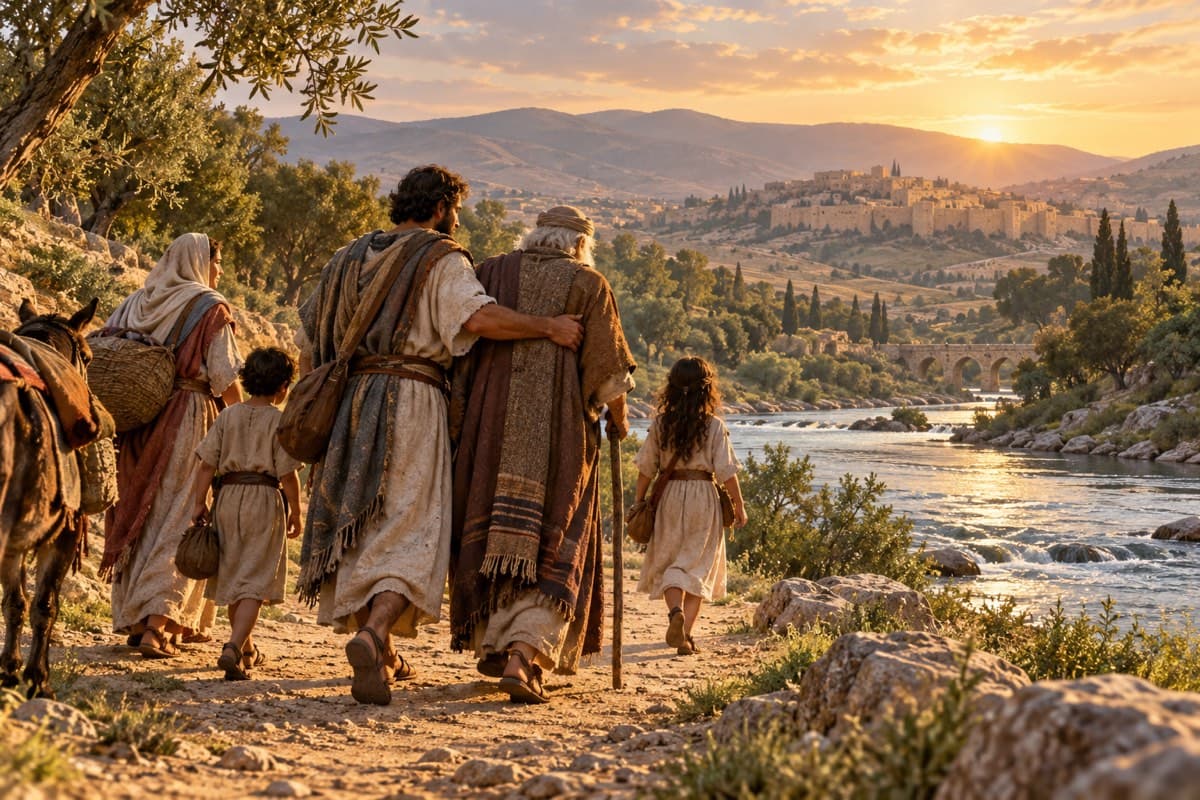
Jeremiah 31 describes restoration through the details of a journey. The Lord will gather people from distant places, but the returning company is not an army of the strongest travelers. It includes people who are blind or unable to walk easily, pregnant women, and women in labor. Their presence changes how we picture the promise. God's gathering is not reserved for people who can make an effortless journey. The Lord leads a people whose bodies and circumstances require patient care.
Water and a straight path appear beside this description. These are practical provisions for travelers, not merely pleasant scenery. The Lord's fatherly relationship with Israel takes shape in the way He leads them. They come with weeping, and He accompanies them with supplications. Arrival does not require everyone to stop grieving before they begin. The journey can hold sorrow and divine guidance at the same time.
The chapter also promises renewed planting, singing, and shared abundance. Restoration reaches ordinary life: fields, meals, families, and gatherings. These details keep hope from becoming an abstract assurance that nothing painful really matters. What people have lost matters enough for the Lord to describe its renewal. The text names grief as well as celebration, placing Rachel's bitter weeping near promises of return.
Latter-day Saints read these promises within the Lord's continuing work of gathering Israel through Jesus Christ. A fitting response to that work includes making participation possible for people with different needs. A group may need a slower pace, clearer directions, a ride, or a welcome that does not demand an explanation. These acts do not fulfill every dimension of Jeremiah's prophecy, but they reflect the attentive care within it. The Lord's gathering gives people a place without pretending they all travel in the same way.
Questions to ponder and discuss
- Jeremiah pictures God bringing home people who travel at different speeds. What might a group need to change so nobody gets left behind?Jeremiah 31:8-9
- In Jeremiah’s picture of the journey home, God provides a level path and water. What small kindness can make joining a new group feel less intimidating?Jeremiah 31:8-9
Tuesday, October 27
A covenant carried in the heart
Jeremiah's promise of a new covenant speaks directly to a history of broken relationship. The Lord names Israel and Judah and recalls the covenant associated with bringing their ancestors out of Egypt. Their failure is not ignored. Yet the future is described through God's initiative: He will make a covenant, place His law within them, and be their God. The passage holds accountability and renewed belonging together.
The heart is the location of the promised writing. This image describes more than remembering a rule. It suggests that the Lord's instruction can become part of a person's desires, judgments, and choices. An outward action can begin as a duty and grow into something sincerely valued. The image does not mean that ordinances, teaching, or shared commandments become unnecessary. It describes the kind of inward relationship those outward commitments are meant to nurture.
Knowing the Lord and receiving forgiveness are central to the promise. The passage moves beyond the appearance of compliance toward a people who belong to God and know Him. Forgiveness is not presented as an optional addition for an otherwise flawless community. It is part of the covenant future. A people with a history of failure can continue because the Lord offers more than a record of their mistakes.
Jeremiah 32 adds the promise of one heart and one way, and of the Lord rejoicing to do His people good. In a Latter-day Saint understanding, covenant life centers on Jesus Christ and the relationship with Him entered through sacred ordinances. His grace makes genuine repentance and growth possible. Progress may be uneven, and a strong desire to change may coexist with habits that require patient work. These verses provide language for that work without equating difficulty with abandonment. God is committed to a people becoming faithful from within.
Questions to ponder and discuss
- Jeremiah describes God’s law being written in people’s hearts. What is an everyday sign that someone values a commitment even when nobody is checking?Jeremiah 31:31-34
- Jeremiah promises forgiveness after the people have broken their covenant with God. What helps you believe a fresh start is possible when you have tried to change before?Jeremiah 31:31-34
- Jeremiah contrasts a broken covenant with a law written in the heart. What helps a good habit become something you care about rather than something you only feel required to do?Jeremiah 31:31-34
Wednesday, October 28
A deed kept for another day
Jeremiah buys a field while Jerusalem is under siege. He is confined in the court of the prison, and the message he has delivered to the king predicts the city's fall. The purchase therefore takes place inside the very crisis that makes owning land seem insecure. The Lord's promise does not arrive after the threat disappears. It takes material form while the threat is still present.
The account lingers over the transaction. Jeremiah weighs silver, signs and seals the purchase documents, takes witnesses, and gives the documents to Baruch. He directs that they be placed in an earthen vessel so they will last. These details make hope tangible. The promise that houses, fields, and vineyards will again be possessed in the land is represented by a real deed that needs preserving for a later time.
After obeying, Jeremiah prays. His prayer remembers God's power and the history of Israel, but it also names what he can see: siege works, military danger, famine, and disease. He ends by bringing the puzzling purchase before the Lord. Faith has not removed the tension between the promise and the circumstances. Jeremiah's willingness to state that tension is part of the scriptural account, not an embarrassing interruption to it.
The Lord's answer reaffirms His power and acknowledges that the city will indeed fall. Restoration does not require pretending the coming devastation is unreal. The field points beyond it. This does not turn the passage into general advice to take financial risks whenever an outcome feels hopeful. Jeremiah receives a particular prophetic instruction. Its wider witness is that God's future can justify faithful work whose benefits are not immediate. Preserving what matters, caring for land, teaching children, and keeping honest records can all express concern for a future beyond today's crisis.
Questions to ponder and discuss
- Jeremiah buys a field while an enemy army surrounds the city, then asks God about it. What would you want to understand if you were in Jeremiah’s place?Jeremiah 32:6-16, 24-25
- Jeremiah preserves the deed to land that cannot offer immediate security. What is something people can care for today that may mainly benefit a later generation?Jeremiah 32:6-16, 24-25
Thursday, October 29
The sound of a restored city
Jeremiah 33 begins with the prophet still confined. The invitation to call upon the Lord therefore comes in a setting of restricted freedom rather than comfortable distance from suffering. The surrounding city bears the effects of war. Against that background, the Lord speaks of healing, cleansing, and restoration. The promise does not overlook the city's wrongdoing or the devastation associated with it.
One of the chapter's most vivid movements is from silence to sound. Places described as empty of people and animals will again hear gladness, wedding celebrations, and thanksgiving. A ruined city becomes a place where life is shared. The promise is not limited to repaired walls. It includes the relationships and ordinary activities that make a place a community.
The chapter also describes shepherds counting their flocks as they pass beneath their hands. This image brings restoration down to the scale of attentive daily work. People will again have livelihoods, animals to care for, and routines that presume a livable future. Such details matter because war disrupts far more than buildings. The restoration reaches the practices through which people sustain one another.
The promised righteous Branch from David's line gives this hope a moral center. Justice and righteousness are essential to the future the Lord describes. From a Latter-day Saint Christian perspective, the promise points to Jesus Christ, the Messiah. His saving work is not simply permission to resume the conditions that produced the earlier ruin. It opens a future shaped by righteousness. That distinction matters wherever people try to rebuild trust. Cheerful language and fresh activity cannot substitute for fair treatment, truthful acknowledgment, and changed conduct. A restored community needs both the sound of joy and the substance of justice.
Questions to ponder and discuss
- Jeremiah describes weddings and songs returning to silent streets. What ordinary sound makes a place feel alive to you?Jeremiah 33:10-16
- Jeremiah’s promised ruler brings justice and righteousness, not just a happier mood. What would rebuilding trust require in a community where people have been treated unfairly?Jeremiah 33:10-16
- Jeremiah pictures shepherds counting their flocks again in places once left empty. What ordinary routine can help a place start to feel like home again?Jeremiah 33:12-13
Friday, October 30
The words survive the fire
Jeremiah 36 begins with a purpose for writing: the people may hear the warning, turn from wrongdoing, and receive forgiveness. The scroll is not presented as a device for humiliating them. It preserves a message that invites a different response while there is still an opportunity to respond. Jeremiah dictates, Baruch writes, and Baruch then reads the words aloud because Jeremiah cannot go himself.
The chapter traces several different reactions. Some officials are alarmed and want the king to hear. They ask about how the scroll was written and advise Baruch and Jeremiah to hide. The king responds differently. As portions are read, he cuts them away and burns them. Several people urge him not to burn the scroll, but their appeals do not stop him.
The physical destruction makes the king's resistance visible. Removing the record does not answer the warning or undo the conditions it names. The narrative then moves from the fire back to writing. The Lord commands another scroll, and Jeremiah dictates again to Baruch, with additional words. The message outlasts the king's attempt to control it.
This account gives a serious picture of receiving scripture. Reading is not only exposure to familiar language; it can involve allowing an unwelcome truth to interrupt a preferred story about ourselves. The passage also honors the patient labor of preservation. Baruch's writing and reading are essential even though he is not the prophetic source of the message. The repeated work is neither glamorous nor easy to measure by immediate success. It matters because the Lord's invitation is not exhausted by one rejection. For modern readers, the chapter supports careful listening, honest response, and gratitude for those whose labor makes scripture available, without treating every human criticism as if it were a prophetic command.
Questions to ponder and discuss
- Jehoiakim destroys a warning instead of responding to it. What makes uncomfortable advice easier to consider without immediately becoming defensive?Jeremiah 36:1-8, 20-32
- When the king burns Jeremiah’s message, Baruch has to write it out again. What could help someone start over when another person has deliberately undone their work?Jeremiah 36:1-8, 20-32
Saturday, October 31
Courage with cloth around the ropes
Jeremiah is lowered into a muddy pit after officials accuse him of weakening the people's resolve. He sinks into the mire, and the account makes his danger concrete. Ebed-melech, an Ethiopian servant in the royal household, hears what has happened and goes to the king. He names the officials' action as wrong and explains that Jeremiah is likely to die. His response begins with truthful advocacy on behalf of someone who cannot rescue himself.
With the king's permission, Ebed-melech gathers help. Before lowering the ropes, he collects worn cloths and instructs Jeremiah to place them under his arms. The cloths are a small detail, but they change the quality of the rescue. Getting a person out alive matters; reducing the pain of the rescue matters too. Courage and gentleness are not competing virtues in this scene.
Jeremiah is lifted out, but he remains in the court of the prison. This is a real rescue rather than the resolution of every problem. The distinction is important. A faithful act can reduce immediate harm even when the wider situation remains unjust or dangerous. The value of the act does not depend on its solving everything.
The Lord later gives Ebed-melech a personal promise of deliverance amid the city's approaching destruction. The message recognizes his trust in God. Readers should honor the particular promise without converting it into a guarantee that every courageous intervention will be safe. The narrative offers a strong model of concrete care: hear what is happening, speak truthfully, use available authority, recruit help, and attend to the person's bodily needs. Its moral force lies in those actions, not in an invented account of Ebed-melech's private thoughts. The text allows his care to be seen through what he actually does.
Questions to ponder and discuss
- Ebed-melech uses old cloths to keep the rescue ropes from hurting Jeremiah. What makes help feel respectful rather than embarrassing?Jeremiah 38:6-13; Jeremiah 39:15-18
- Ebed-melech speaks up when powerful officials have mistreated Jeremiah. What can help someone raise a concern when staying quiet would feel safer?Jeremiah 38:6-13; Jeremiah 39:15-18
- Ebed-melech finds helpers instead of trying to lift Jeremiah out alone. What makes it easier to ask other people to join in helping someone?Jeremiah 38:6-13; Jeremiah 39:15-18
Sunday, November 1
Hope that does not silence grief
Lamentations preserves sorrow after Jerusalem's destruction. The city is pictured as lonely and weeping, and the absence of comfort is repeated. These poems do not hurry toward a lesson that makes the pain seem simple. They give grief language. Their place in scripture matters: the voice of a wounded people is included in the record of their relationship with God.
Chapter 3 begins with images of confinement, darkness, and loss of peace. The speaker remembers suffering intensely. Then the poem turns toward the Lord's compassion and faithfulness. That turn does not erase the earlier words. Hope enters a memory still marked by pain. The Lord's mercies are described as new each morning, giving hope a recurring, daily shape rather than making it depend on one dramatic change in circumstances.
The chapter later returns to lament, confession, and pleas for God to hear. Its movement is therefore more complex than a straight line from sadness to permanent cheerfulness. Readers should not require grieving people to remain at the hopeful verses as proof that they have learned the right lesson. The whole poem holds suffering, moral reflection, and dependence on God together.
A Christian reading finds reason to hope in the Savior's compassion and power to redeem, while recognizing that not all suffering is caused by the sufferer's personal sin. The poems address Jerusalem's particular catastrophe and covenant history. They do not justify assigning blame to every person who experiences loss. Nor should language about waiting be used to tell someone to remain in an unsafe situation. The Lord's compassion is compatible with seeking protection and receiving practical help. Hope can be present in the decision to pray honestly, accept companionship, or continue through one more day while the larger outcome remains unresolved.
Questions to ponder and discuss
- Lamentations makes room for both tears and hope. What can a friend say that offers hope without rushing someone to feel better?Lamentations 1:1-2, 16; Lamentations 3:19-26
- The writer of Lamentations remembers mercy without pretending the loss is gone. What might a hopeful day look like for someone whose situation has not improved yet?Lamentations 1:1-2, 16; Lamentations 3:19-26
- Lamentations includes prayers full of grief. What can help someone pray honestly when they have nothing hopeful to say?Lamentations 1:1-2, 16; Lamentations 3:19-26
These are supplemental study notes written by Rooted, an independent app not affiliated with The Church of Jesus Christ of Latter-day Saints. For the official lesson, see Come, Follow Me on churchofjesuschrist.org.